The AI Proficiency Report
The bar for AI proficiency is rising, but companies are failing to meet it
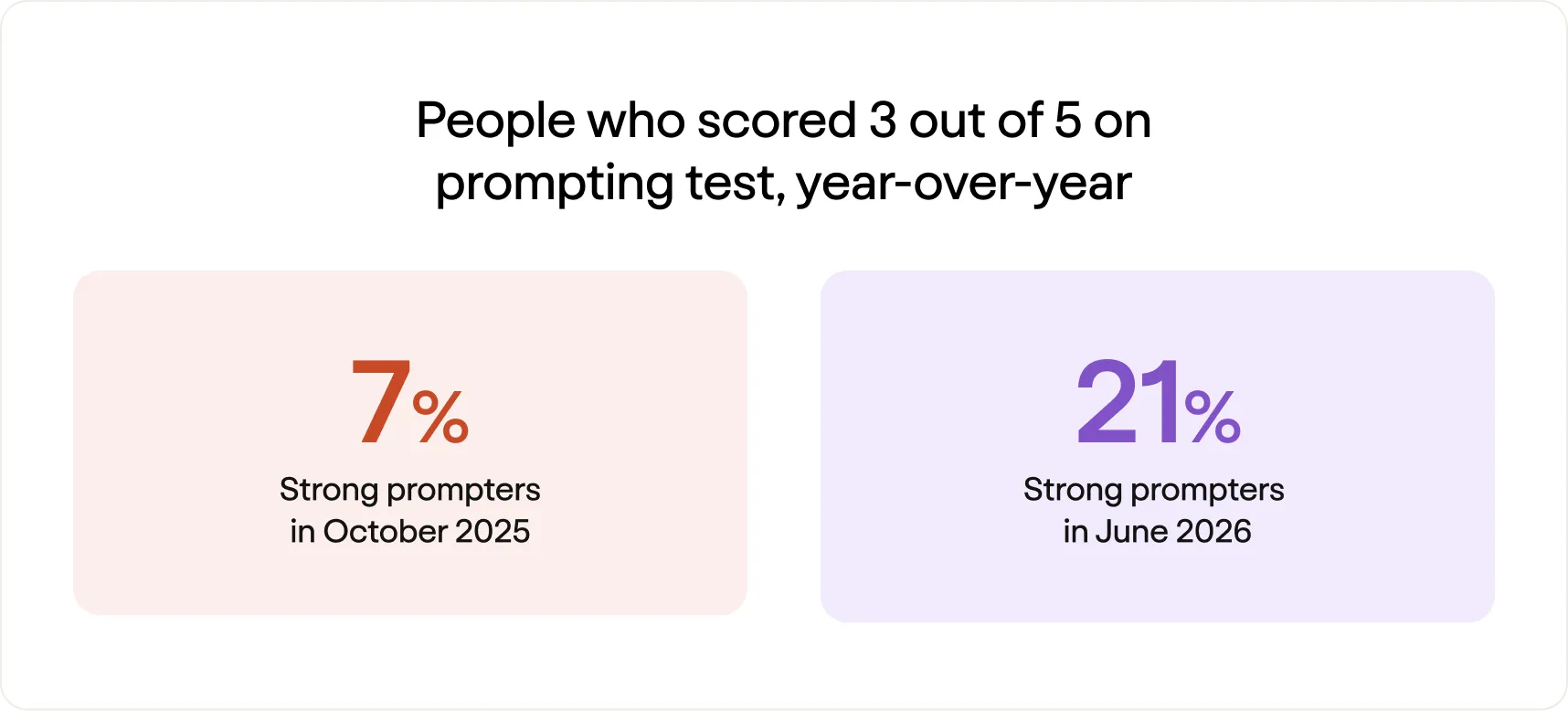
In 2025, “AI proficiency” meant something pretty basic: Do your people know how to use AI safely and write a decent prompt?
Companies have spent the last year focused on this type of proficiency, with predictable results: Employees now know what AI is and how to use it responsibly. They know how to write a prompt and use AI to summarize emails.
But as AI advances, the bar for proficiency is rising. In 2026, AI proficiency will require incorporating AI into meaningful, value-adding work tasks every week. This is the “gap” we have to cross to achieve enterprise ROI from AI.
This isn't happening - which explains the paradox in corporate America. ChatGPT reports nearly 900 million monthly users and 56% of Americans say they use AI, yet 85% of the workforce does not have a value-driving AI use case and 25% don't use AI for work at all. Even in populations we'd expect to be ahead - tech companies and language-intensive functions - most AI use remains surface-level.
Worse, executives are in the dark about this gap.
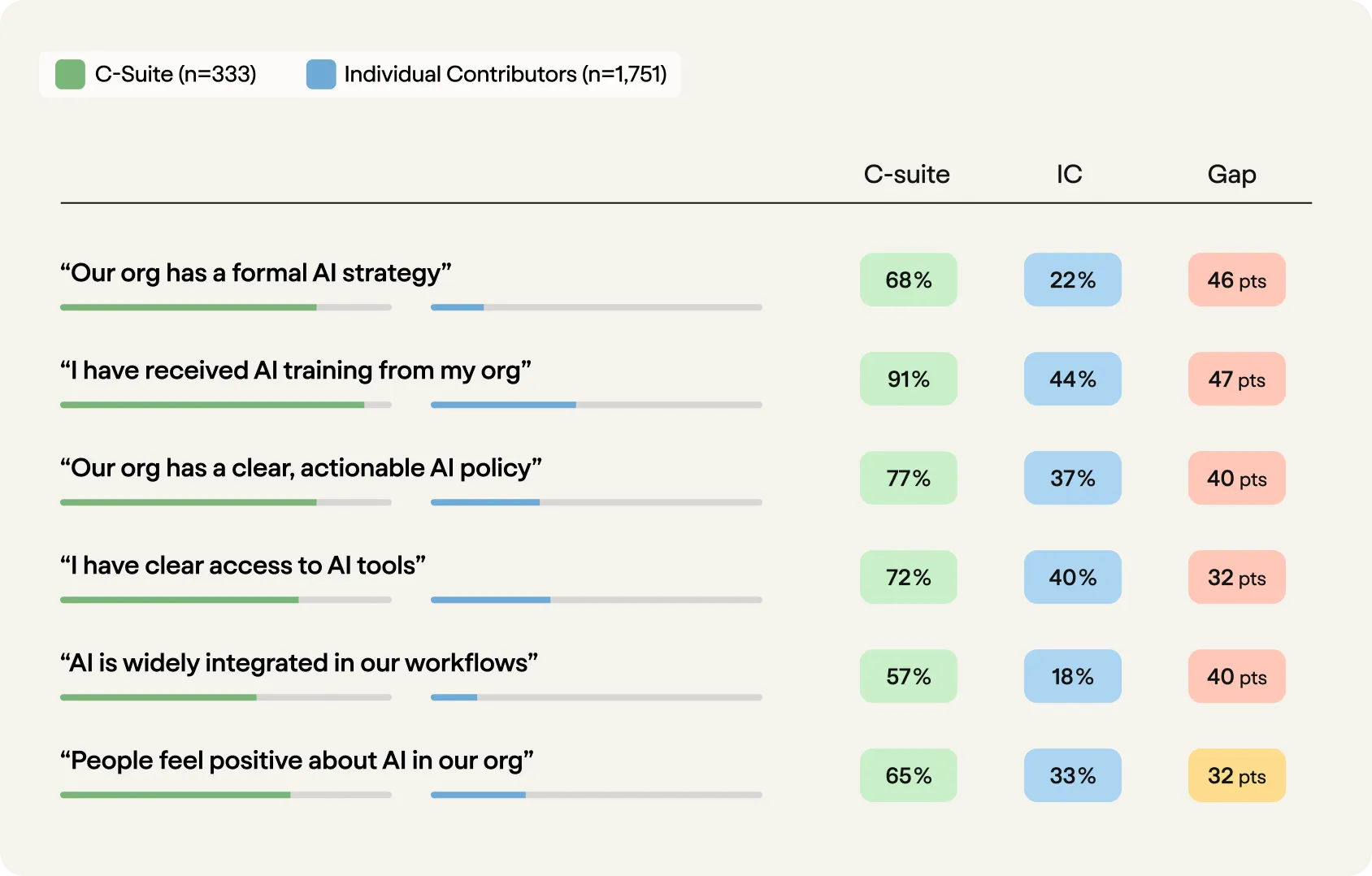
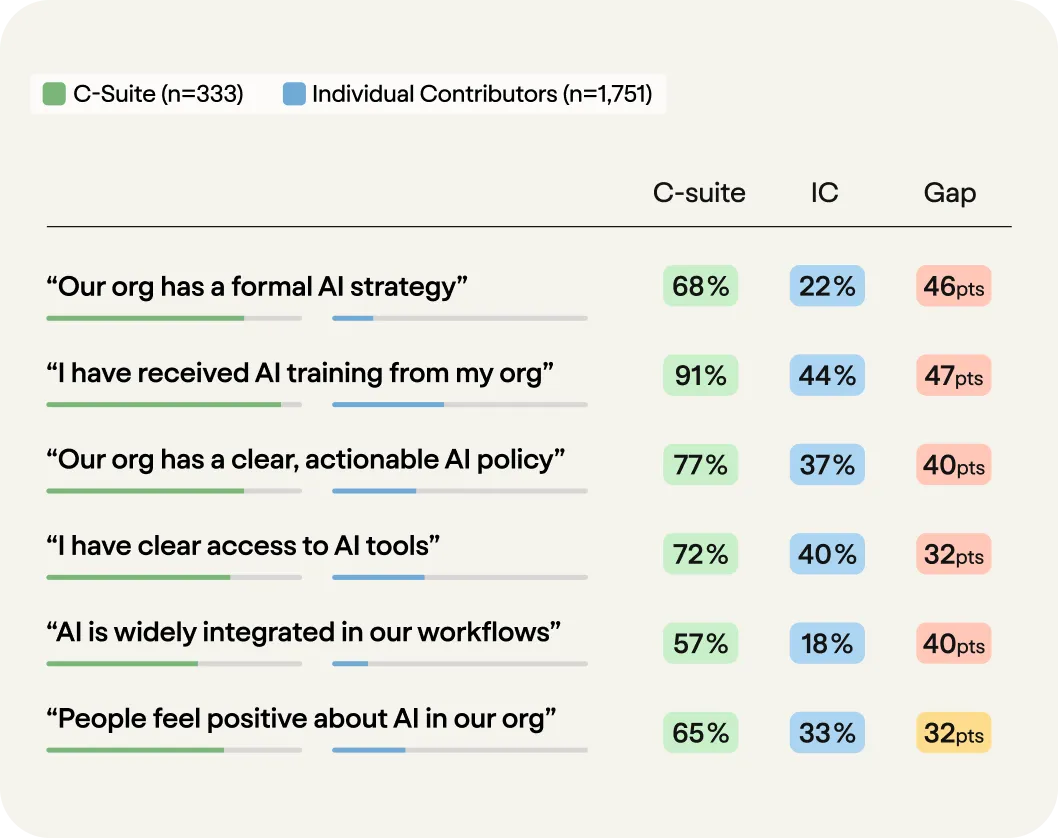
Executives we surveyed overwhelmingly said their company has a clear AI strategy, that adoption is widespread, and that employees are encouraged to experiment and build their own solutions. The rest of the workforce disagrees.
Last year, companies scrambled to invest in table-stakes skills. But the bar forAI proficiency moved faster than the work force. Now, the real work begins.This report should serve as truth serum for leaders - and a mandate to get your team to the new (and still changing) bar.

Download the report for free and get the full status of AI proficiency in 2026.
We surveyed 5,000 knowledge workers from 1,000+-person companies in the U.S., U.K., and Canada and analyzed the following characteristics and behaviors.

AI knowledge
Understanding of how AI works, its limitations, and how to use AI toolssafely to protect data and mitigate bias
.png)
AI usage
Frequency, depth, and breadth of use, including their most valuable use casesand typical behaviors when using AI
.png)
AI skill
Ability to prompt effectively and identify effective applications of AI, measured byhands-on tests rather than self-reporting
.png)
AI attitudes
Feelings about AI and its impact on their work
.png)
Organizational AI readiness
Company actions to encourage or discourage the use of AI,including manager support, company strategy / policies, training, etc.
People are using AI -
just not effectively
.png)
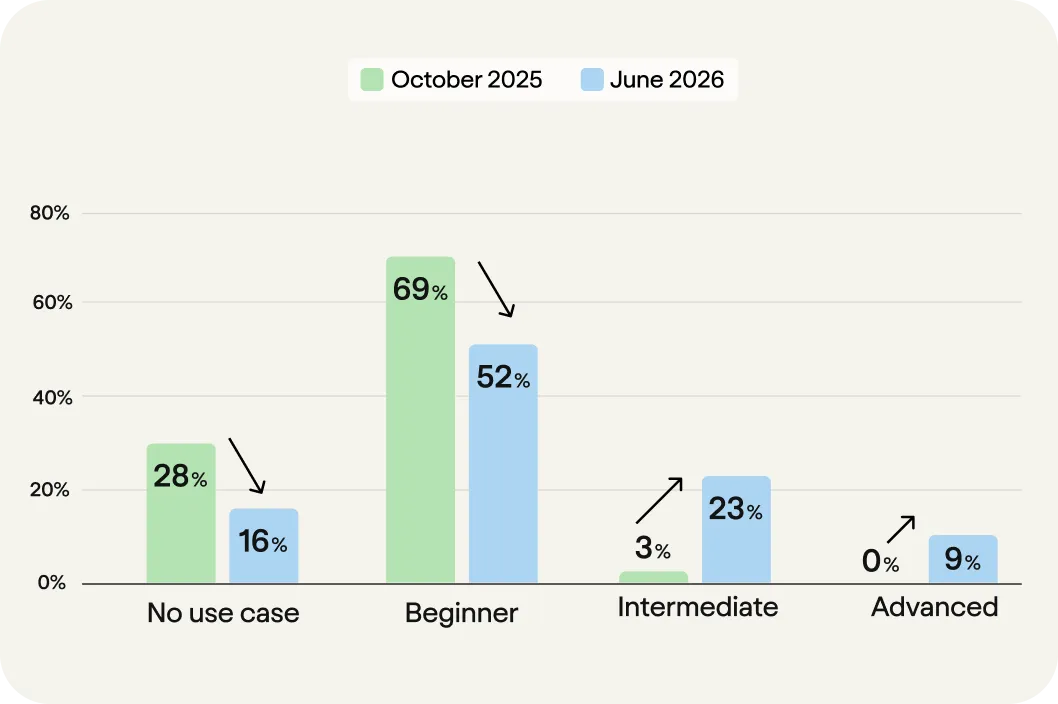
Three years after the launch of ChatGPT, most people are still AI beginners.
70% of the workforce are what we call “AI experimenters” - people who use AI for very basic tasks,like summarizing meeting notes, rewriting emails, and getting quick answers. The second-largestgroup are “AI novices” - those who don’t use AI, or have tried it a few times before bouncing off.
Since May 2025, more people have migrated from “novice” to “experimenter” as they start toplay around with AI. The usage numbers support this - ChatGPT has added 100M+ weekly users since May 2025, and 55% of our respondents said they use AI at least weekly.

But in the last six months, barely anyone has upleveled their AI skills beyond basic prompting. Less than 3% of the workforce are AI practitioners or experts - people who put AI to use in their workflows and see significant productivity gains.


Employees are in a “Use Case Desert”

The biggest challenge in using AI isn’t learning how to prompt – it’s knowing what to use AI for.Across thousands of clients, we observe that employees know how to use an LLM, but bounce off when they can’t think of a use case for it.
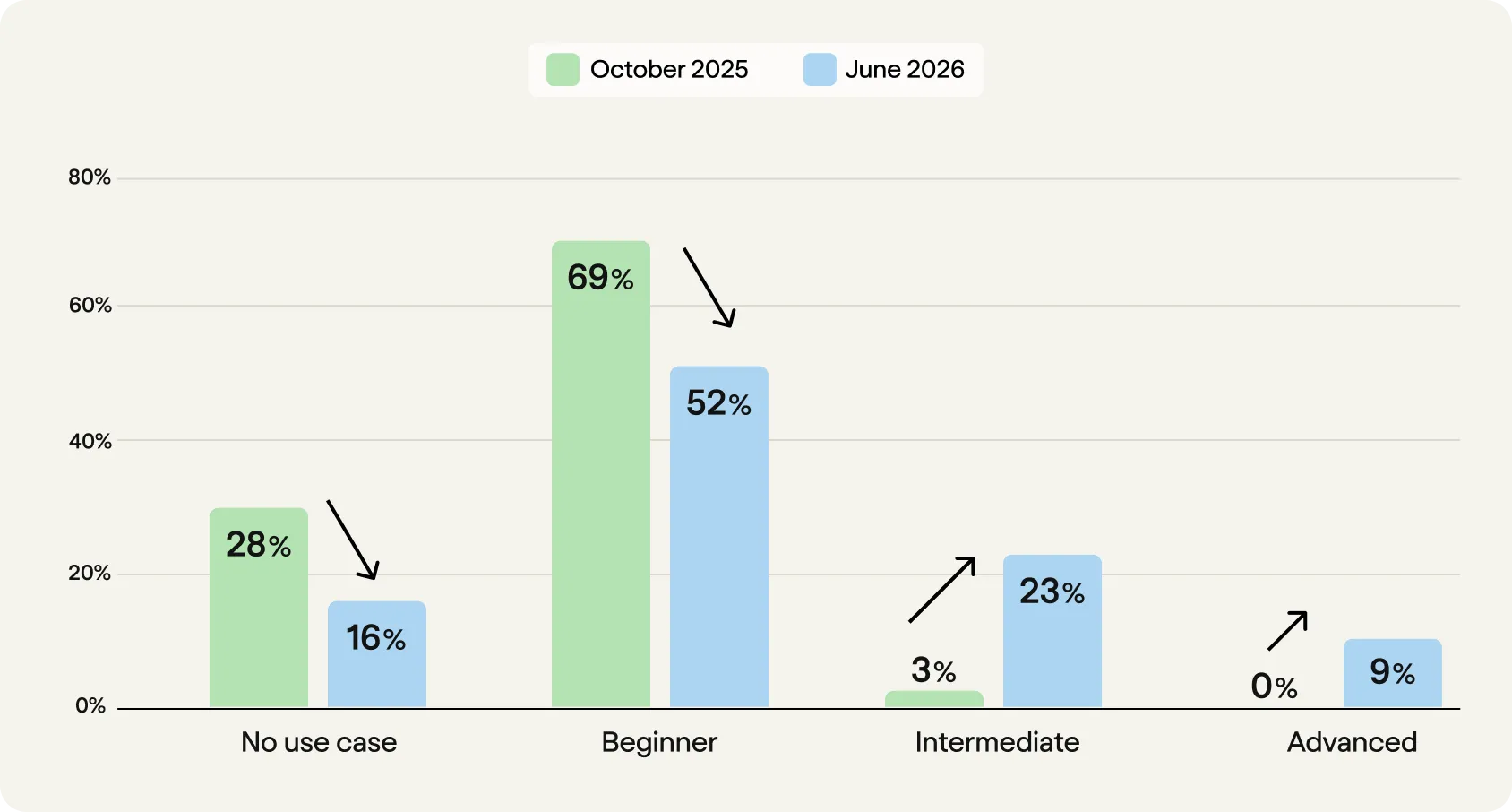
The data backs this up. 26% of respondents said they don’t have a work-related AI use case, and 60% of the workforce said their use cases are beginner-level. According to our analysis of reported use cases, only 15% are likely to generate ROI for the business.
The result: Less than a third of knowledge workers report saving 4+ hours a week with AI - whenmost organizations should be targeting a 10+ hour time savings per employee to generate ROI.
.png)

Most AI use cases are unlikely to generate ROI
.png)
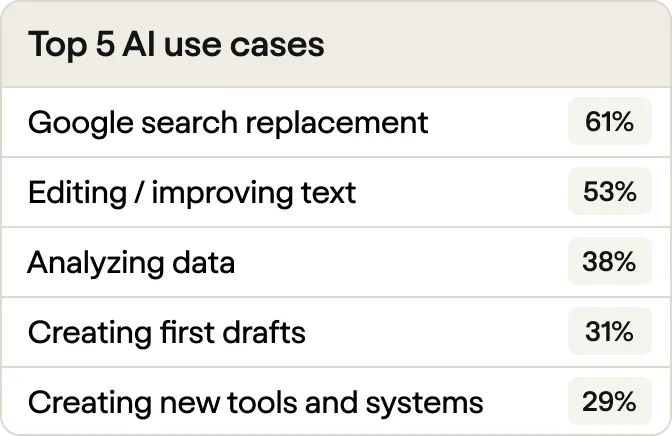
Our analysis of 4,500 work-related AI use cases painted a clear picture: The vast majority of usecases are very basic.
14% of workers say their most valuable AI use case is Google search replacement. About 17%of workers use AI for drafting, editing, and summarizing documents - but only 2% have built automations for copy generation, which would save more time. Only 3% say their most valuable use case is data analysis or code generation.
Of the top 25 reported use cases, only three showed meaningful integration into workflows -automated reporting for data analysis, pattern/anomaly detection in code, and code suggestions/completion.


Top 10 work-related use cases

When we group use cases together by category, writing and research are by far the mostpopular, but both are being used at the beginner level - generating one-off copy suggestions andconducting basic informational searches.

Most workers aren’t saving much time with AI

Because most workers are using AI for very basic tasks, the impact to their productivity is minimal.Nearly a quarter of the workforce (24%) reports saving no time with AI. Another 44% say they save less than 4 hours per week.
Unsurprisingly, workers who are more proficient with AI save more time with it. “AI practitioners”are 1.8x more likely to save more than 4+ hours a week than “AI experimenters,” and 20x more likely to save 4+ hours a week than “AI novices.”

Companies are investing, but it’s not closing the gap

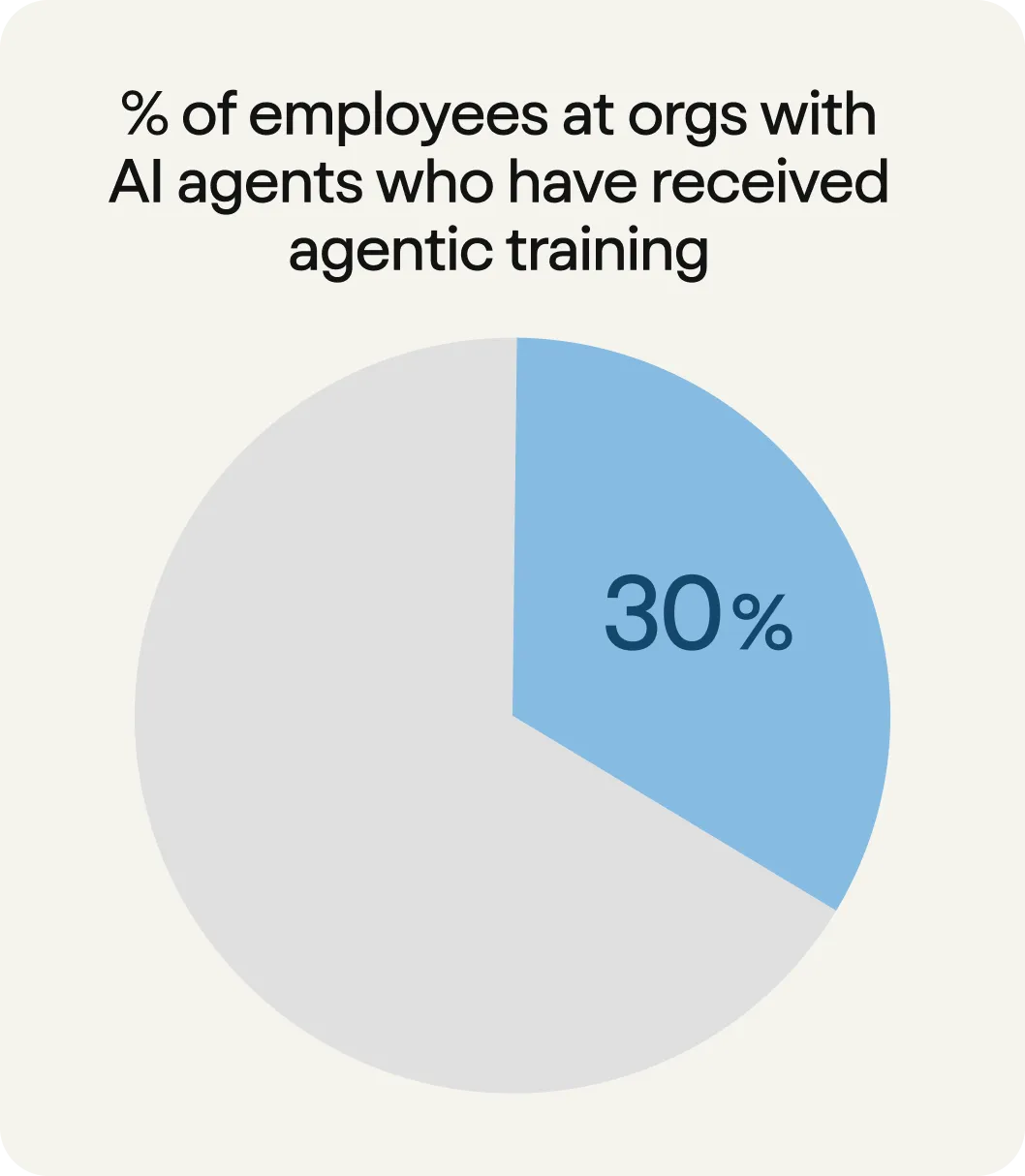
Companies are making the right directional investments. According to our latest survey, 63%percent of respondents say their company has an AI policy, 50% have access to an AI tool, and44% receive AI training from their company.
And these investments do have some impact:
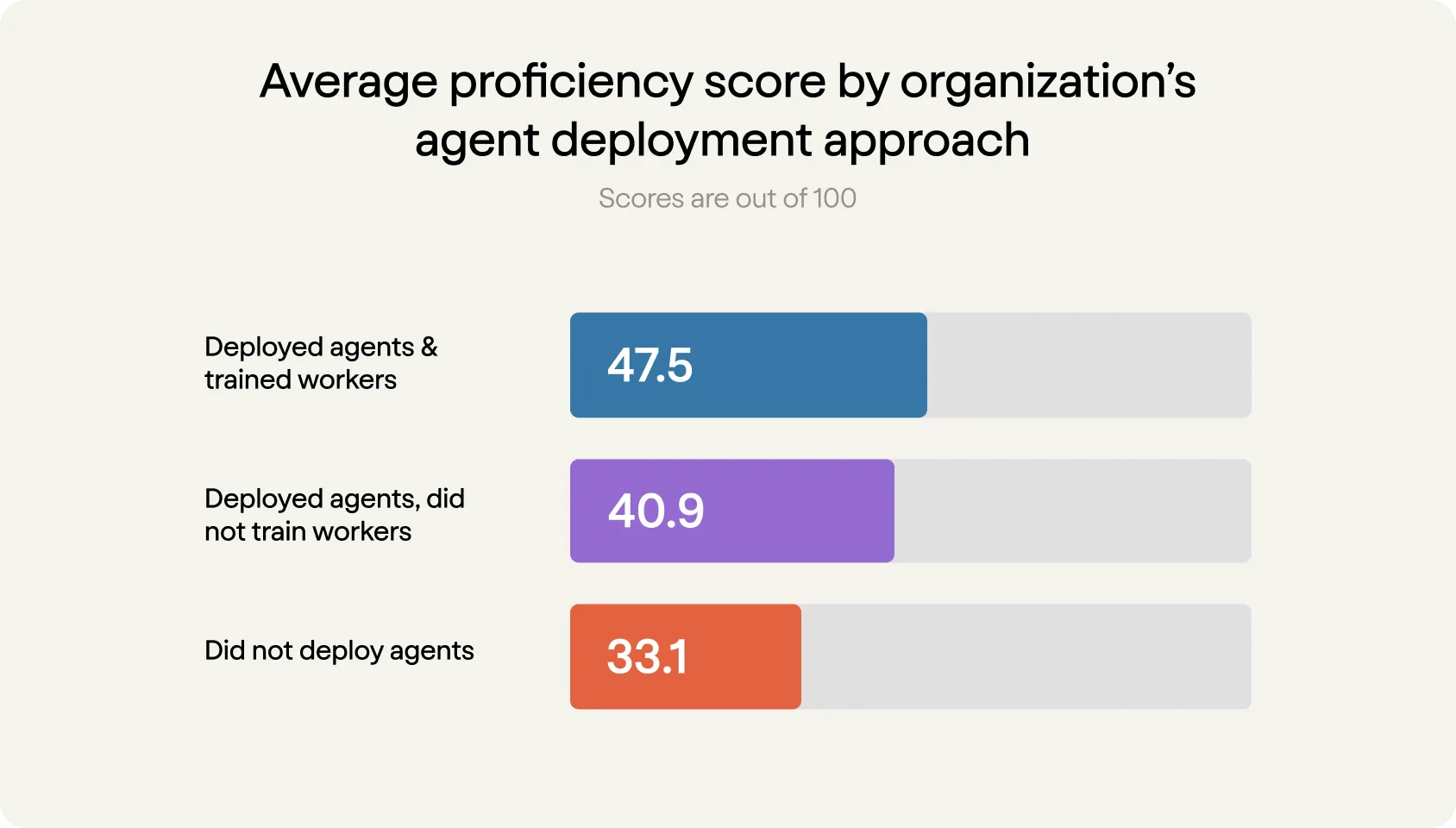
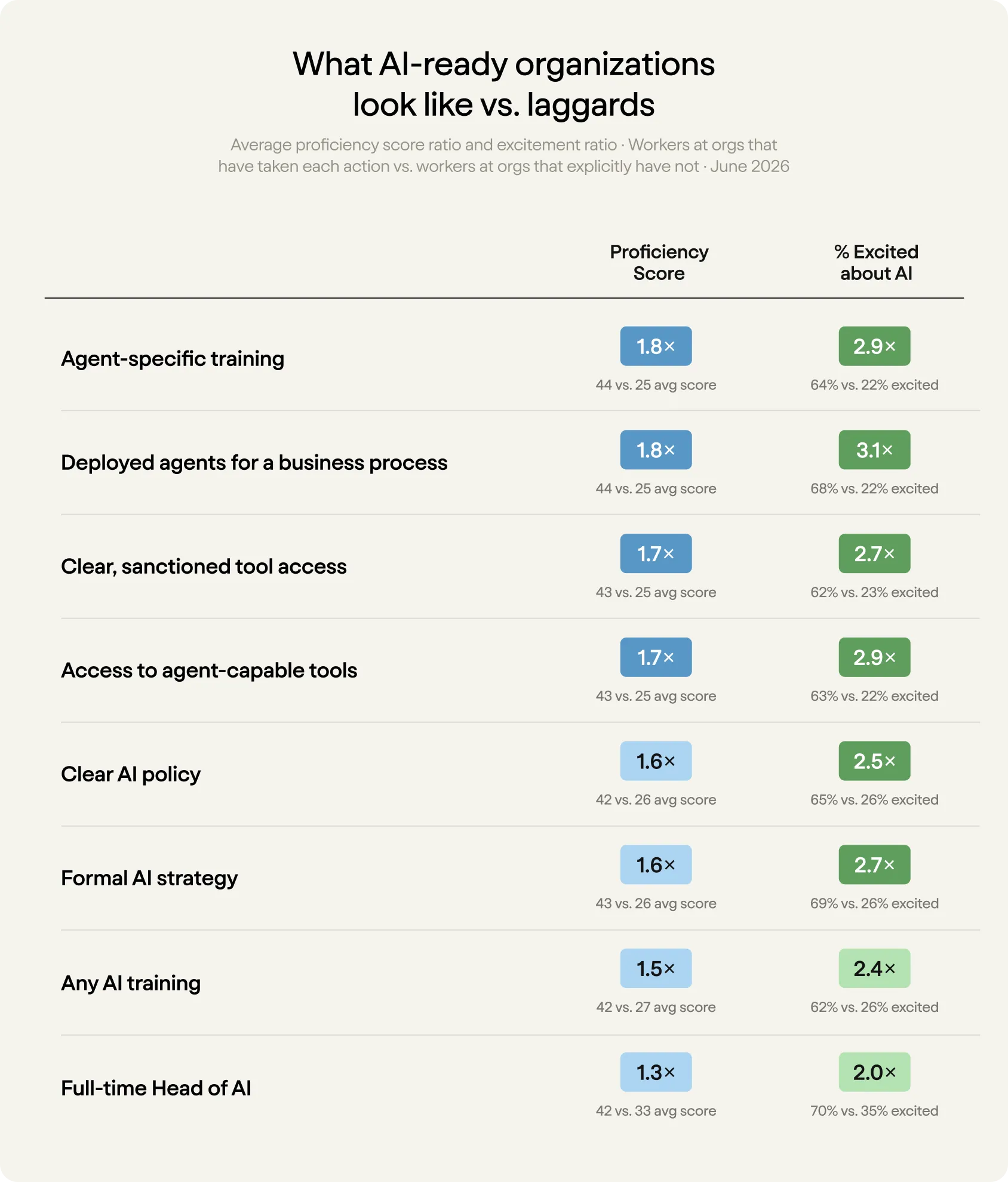
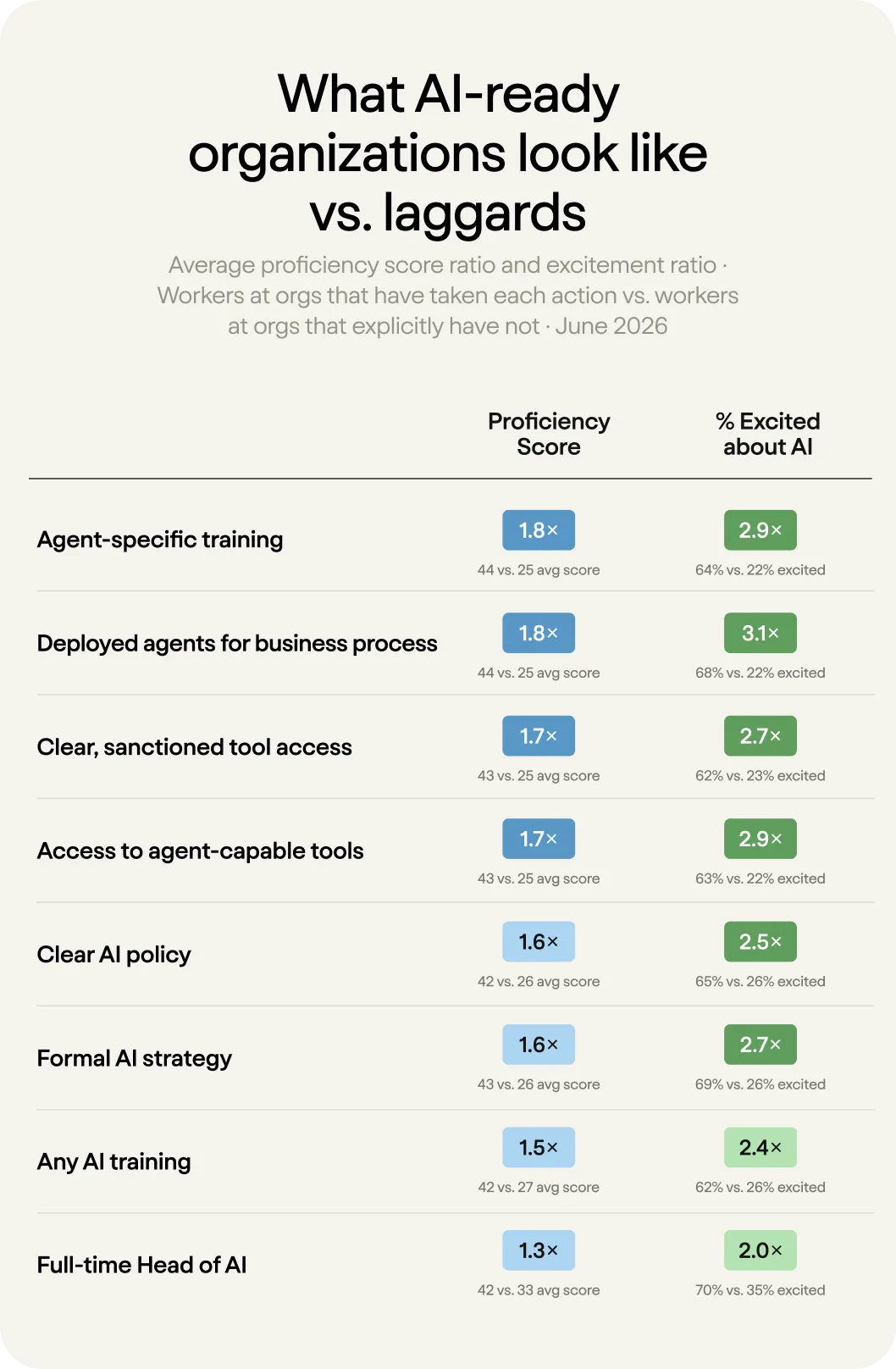
Employees with a company AI strategy are 1.6x more proficient than employees without one
Employees with access to AI tools are 1.5x more proficient than employees with no access
Employees who have been trained on AI are 1.5x more proficient than employees who have not
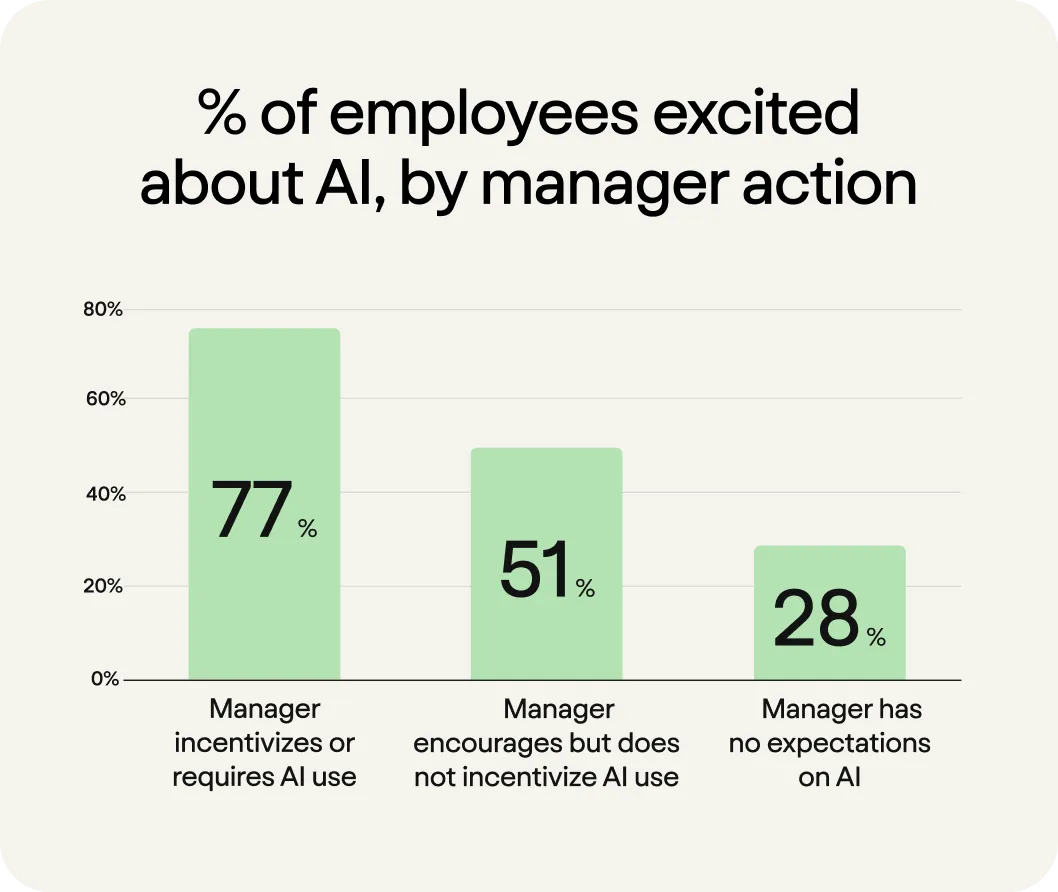
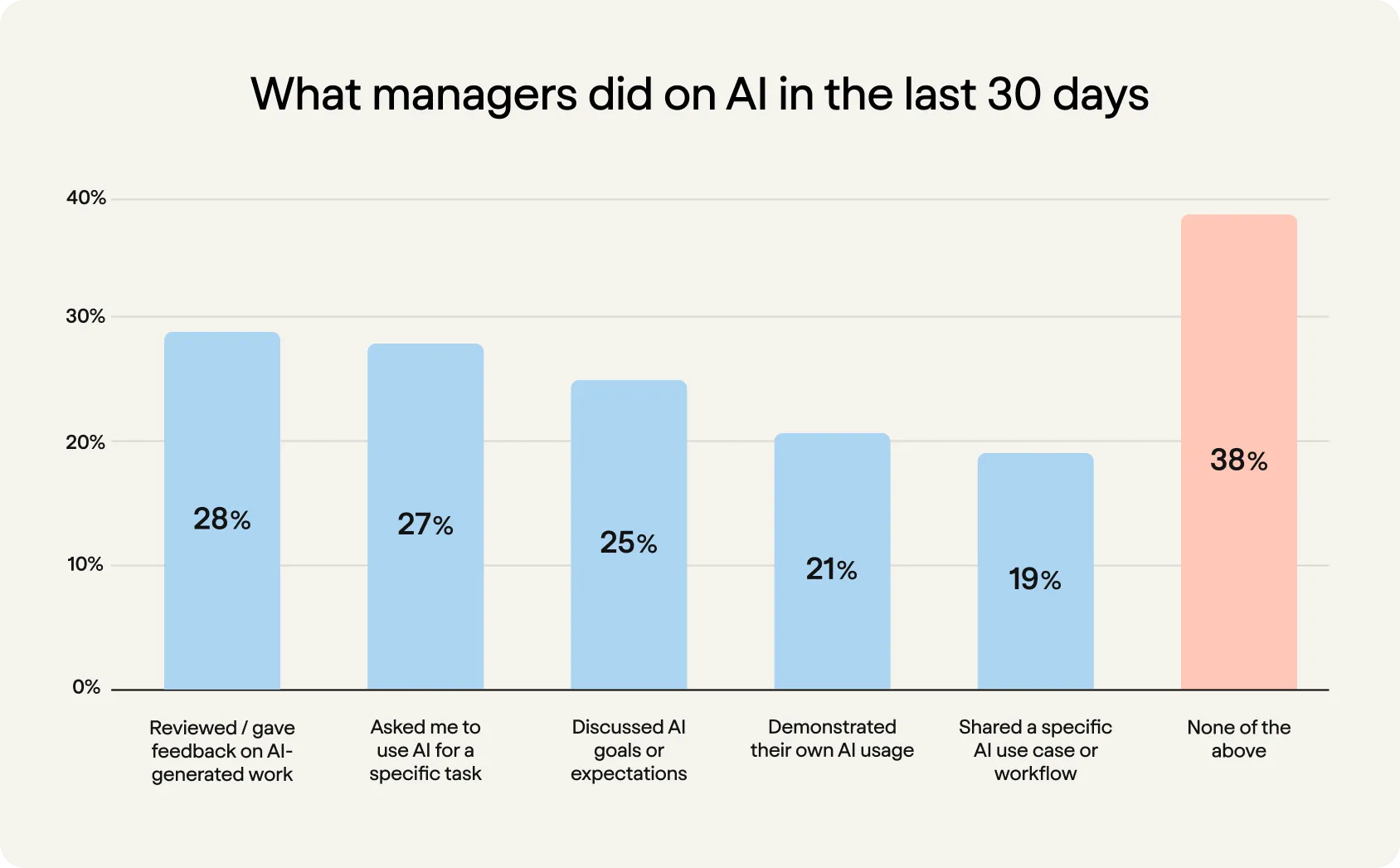
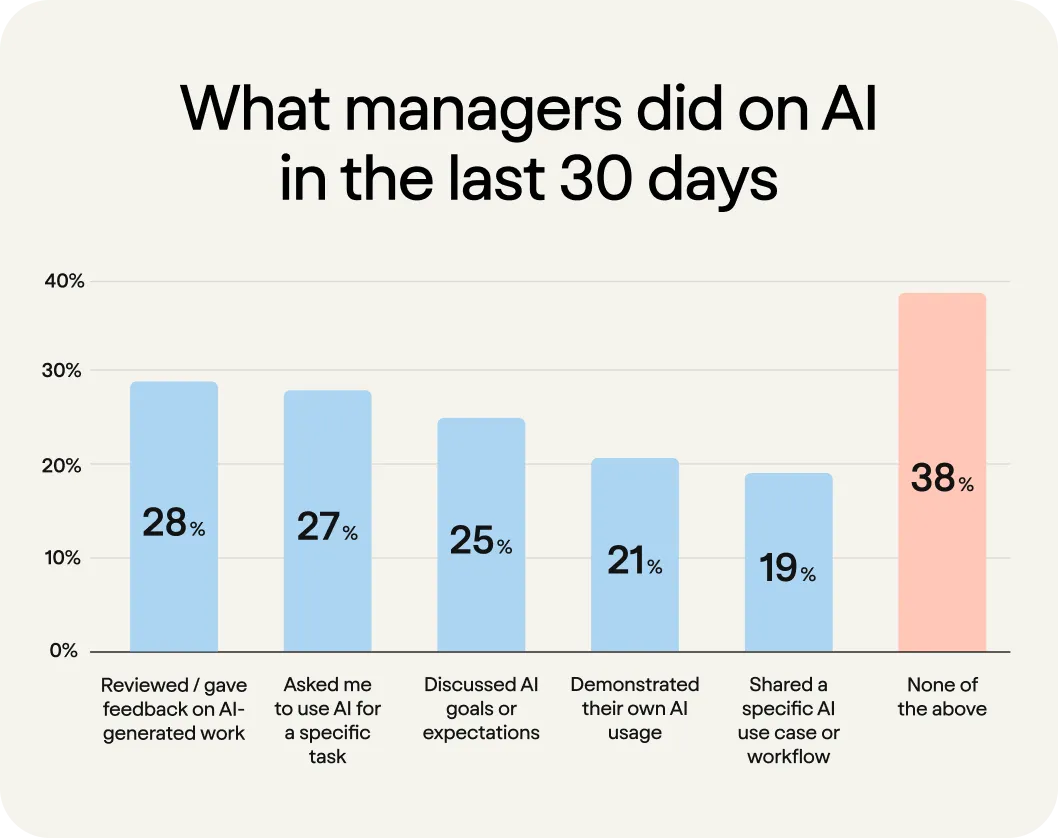
Employees whose managers expect AI usage are 2.6x more proficient than those whose managers discourage it
Clearly training, strategy, and communication moves the needle. The problem is, the “higher proficiency” groups are still not that proficient.
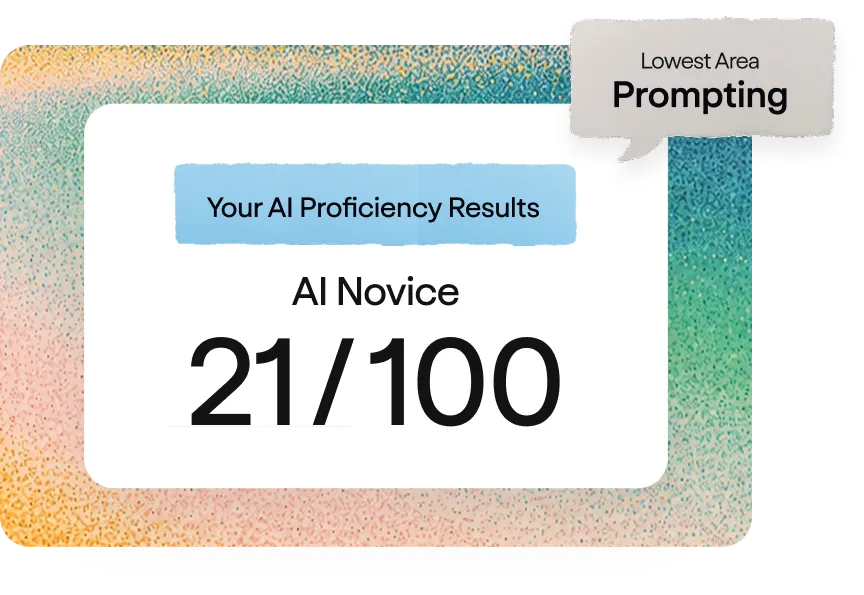
Employees who have undergone AI training score, on average, 40/100 in AI proficiency. They’re still in the “AI experimenter” group - people who know how LLMs work and have a few basic use cases, but haven’t started exploring intermediate and advanced applications of AI.
The most logical reason for this is that most companies are still focused on AI access, safety, and prompting. In other words, they give people an LLM, tell them the basic guardrails, and give them a framework to write a good prompt. That’s the right foundation for using AI, but it doesn’t help “close the gap” between usage and value.
.png)
.png)

Execs think their AI deployments are a success
The rest of the company disagrees
.png)
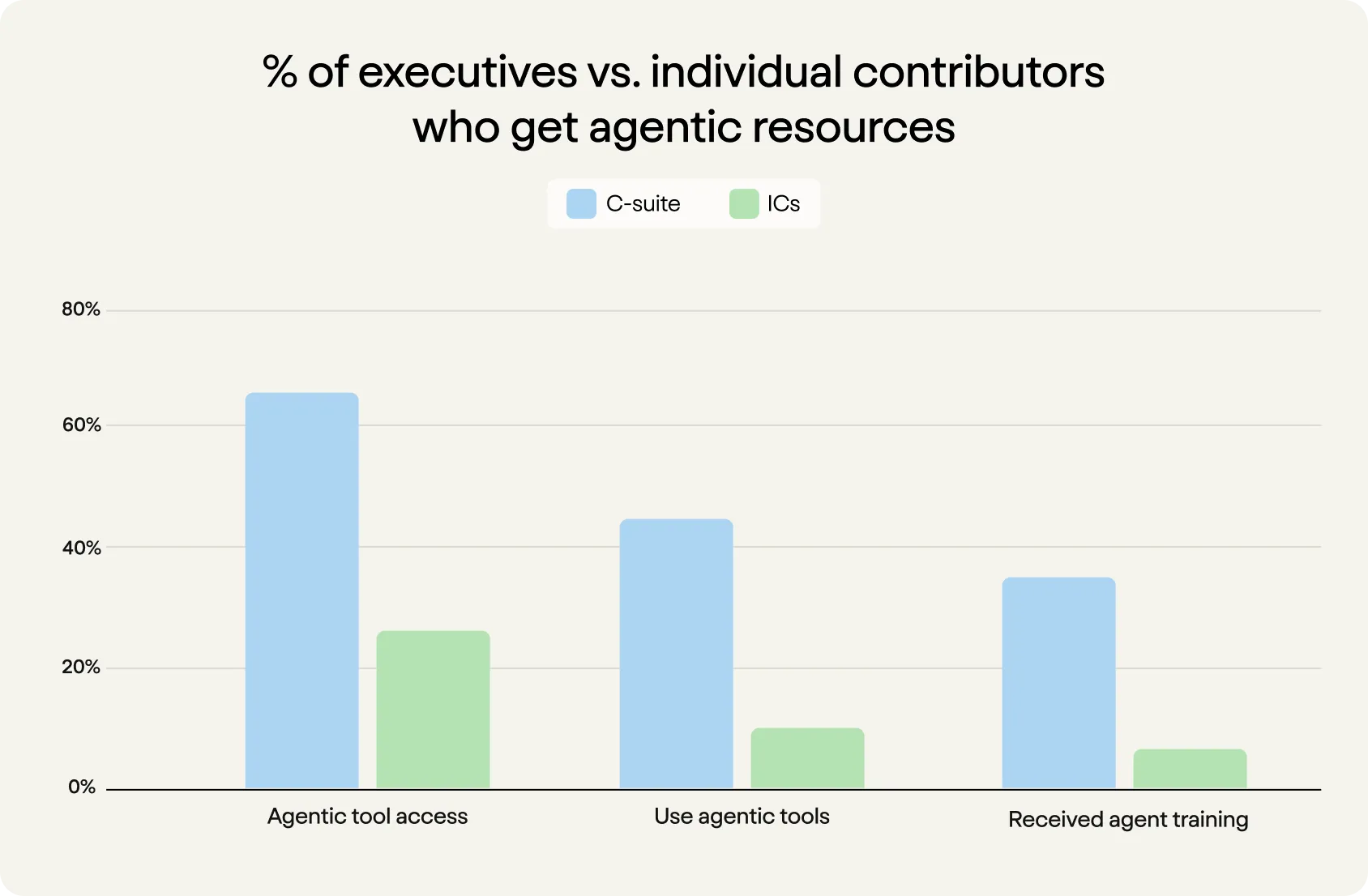
Leadership doesn’t appear to be aware of the gap between usage and value. Overwhelmingly,C-suite respondents believe their company AI deployments are going better than the rest of thecompany does - particularly individual contributors.

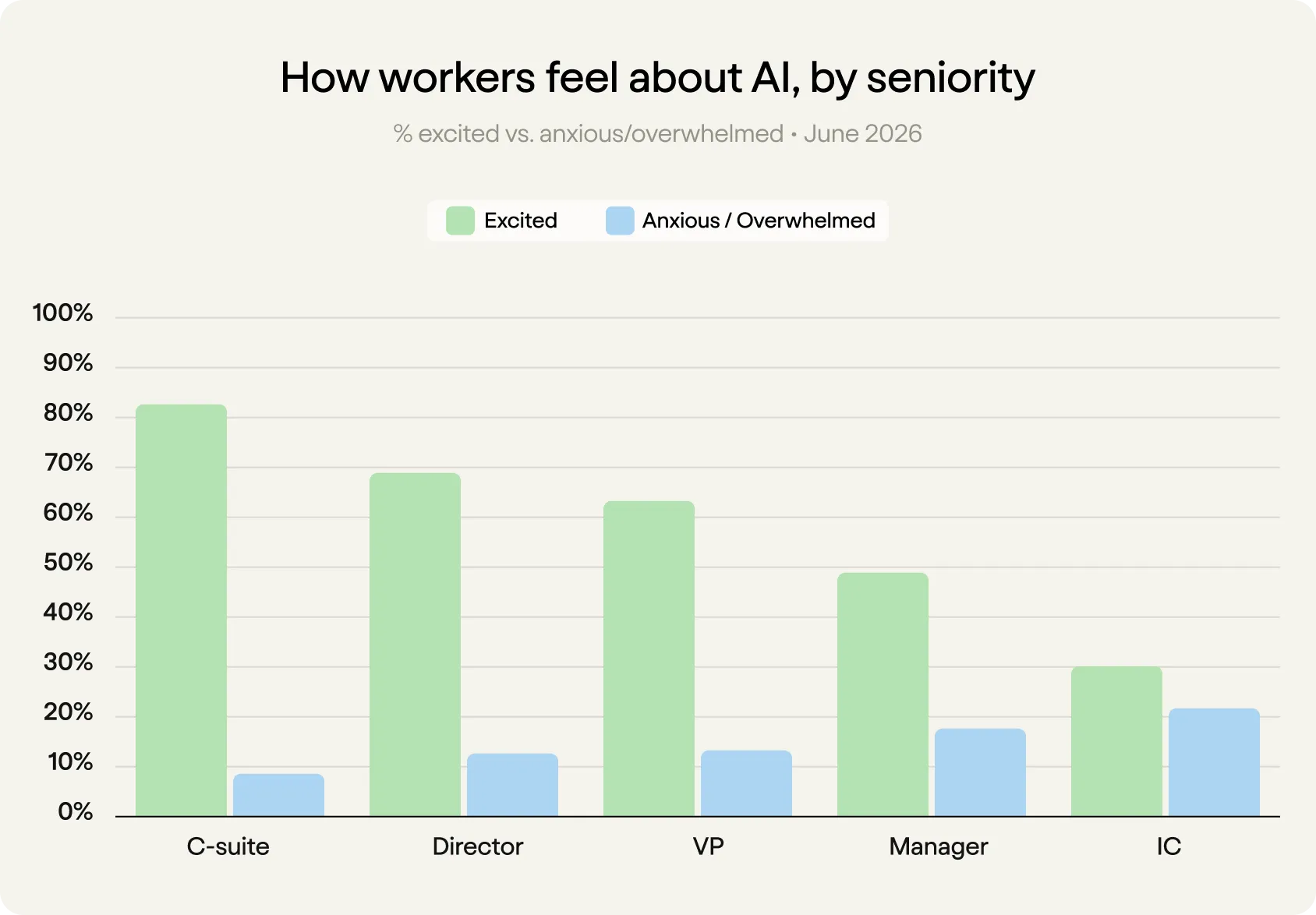
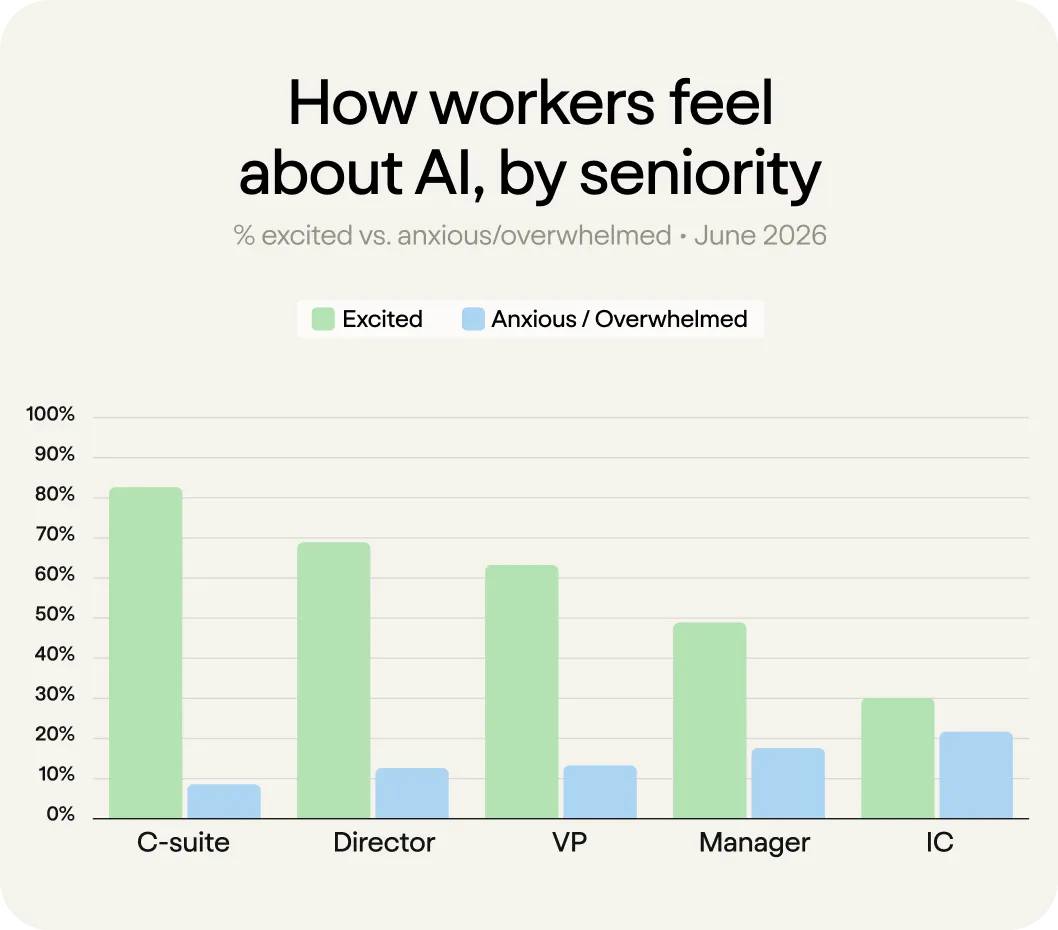
The C-suite also tends to feel overwhelmingly positive about AI. 75% are excited about its implications for them and they have almost complete trust in its contributions (94%). The majority of C-suite members use AI for work daily (57%) – only 2% don’t use AI for work at all.
And yet only 42% of the C-suite think their job will be affected by AI - implying that they don’t consider their roles to be part of their company’s AI transformation.
Individual contributors are being left behind
.png)
Individual contributors - defined as knowledge workers who do not manage a team - currently benefit the least from their company’s AI resources. They’re the least likely of all career stages to have clear access to anAI tool, tool reimbursement, or AI training.

As a result, they’re more likely to be anxious or overwhelmed by AI, less likely to trust it, and least likely to say it’s having a transformative impact on their work.
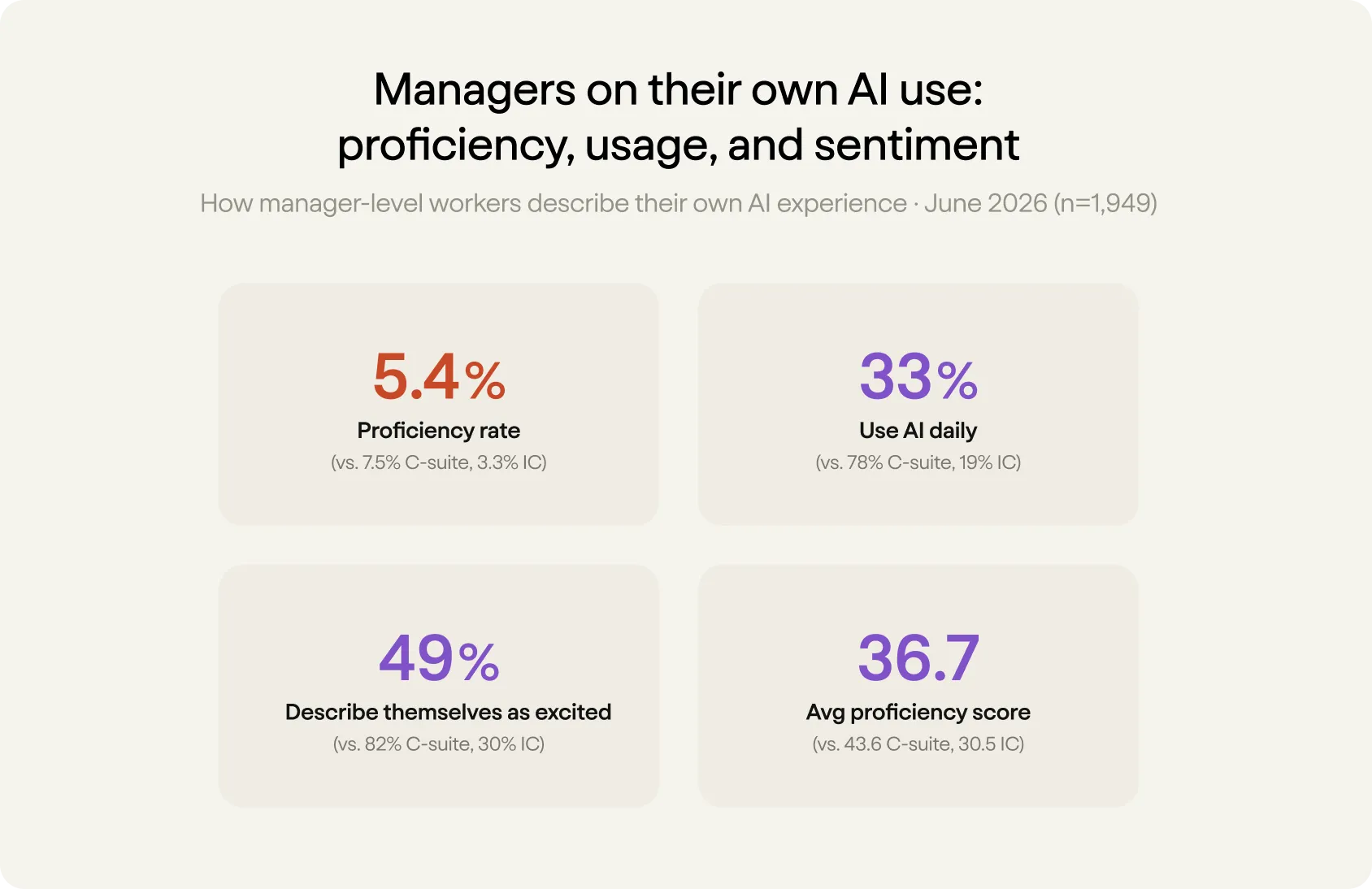
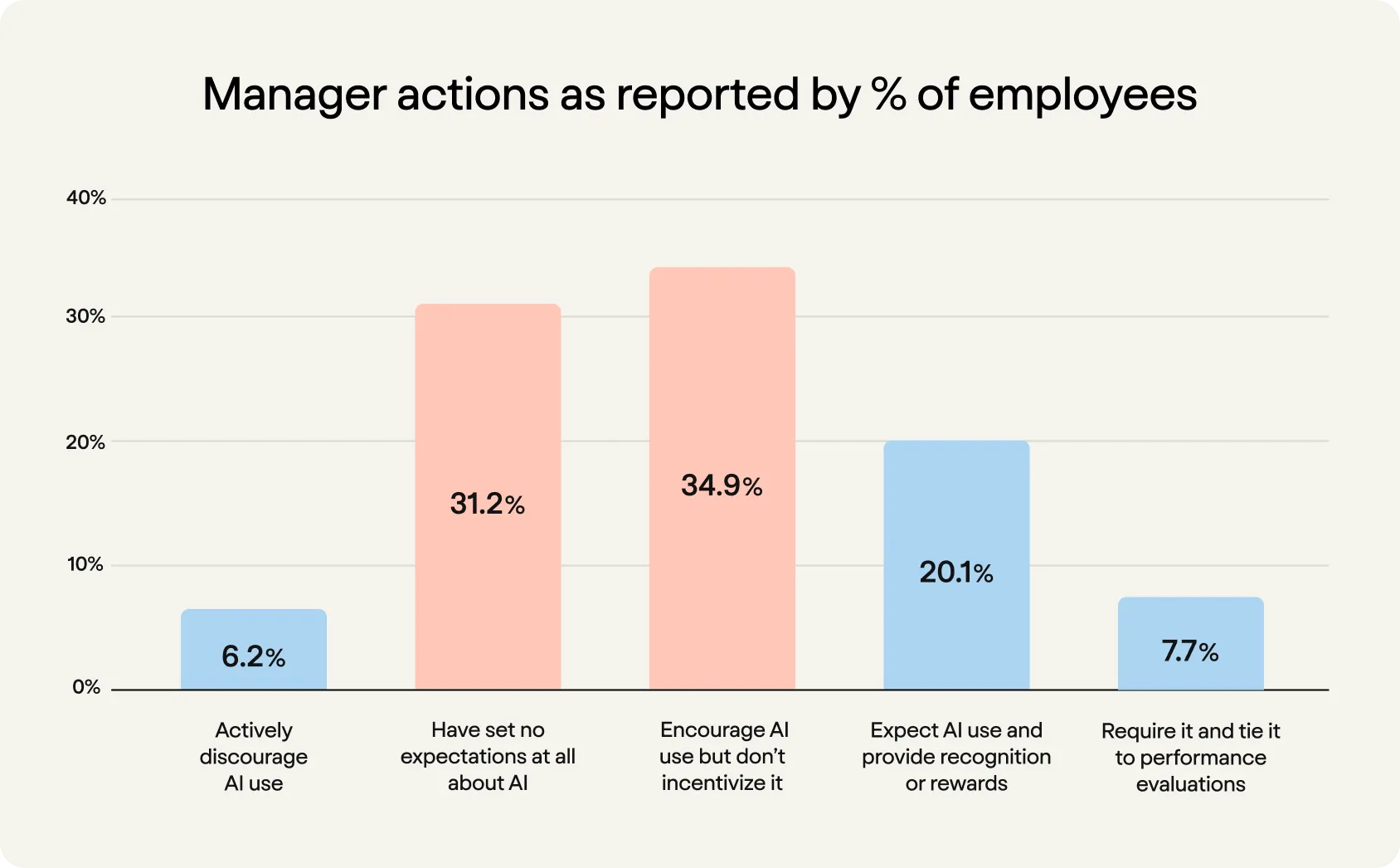
ICs also receive less manager support for AI use since May 2025 – down 11%. Only 7% of ICs say their managers expect daily AI use, and only one-third receive encouragement to use it.

The leading and lagging industries
.png)
Looking at the largest segments in each industry, we’re able to get a picture of how policies impact proficiency and outcomes. Leading sectors - including tech, finance, and consulting - are more likely to have a company AI strategy, policy, and access to tools, while lagging sectors - including healthcare, education, and retail - are more likely to be missing them.

The leading and lagging functions

Engineering, strategy, and business development departments lead in AI proficiency - through their proficiency scores are still quite low.
Customer service, despite having major potential for AI transformation, is last in proficiency, use,and time savings. Marketing, one of the most language-intensive functions, is in the middle of the pack and saves at most 4 hours a week using AI.

The most startling finding: Many functions aren’t using AI for the most obvious or high-value use cases for their role. 54% of engineers don’t use AI for writing or debugging code, scripts or formulas, and 87% of product managers don’t use AI for creating prototypes.


.png)
Download the report for free and get the full status of AI proficiency in 2026.
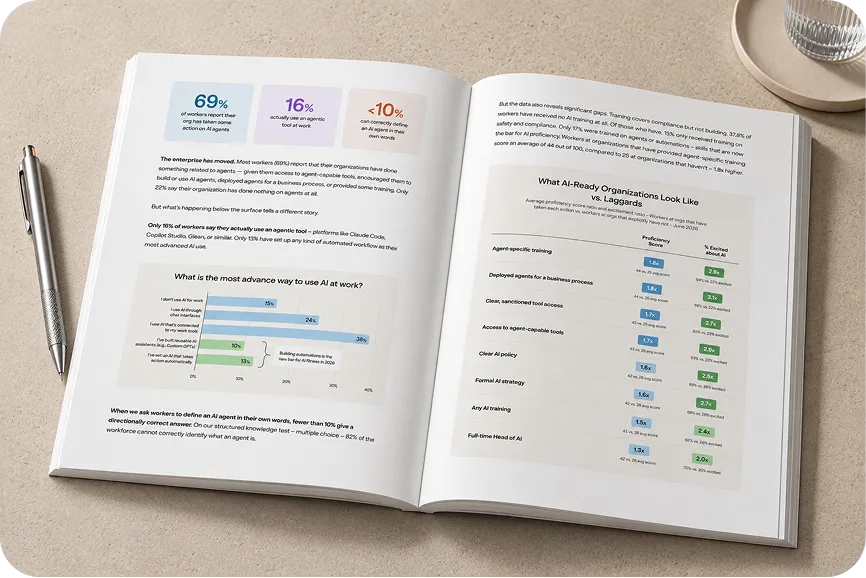
The top mandates for leaders in 2026
The proficiency gap won’t close on its own - and the longer leaders wait, the wider it gets. Here’s what needs to happen now to move your workforce from experimenting with AI togenerating ROI in 2026.

Stop measuring AI success by access and adoption rates.
Understanding of how AI works, its limitations, and how to use AI toolssafely to protect data and mitigate bias
.png)
Treat use case development as a core competency, not a personal responsibility.
The workforce isn’t stuckbecause they can’t prompt. They’re stuckbecause they don’t know what problemsAI can solve in their specific role. Buildfunction-specific use case libraries, createrole-based playbooks, and assign use casedevelopment as a measured responsibilityfor team leads.
.png)
Bridge the IC gap immediately.
Your individual contributors - the people doing the most repetitive, automatable work - have the least access to tools, training, and manager support. This is backwards. Prioritize IC enablement and mandate that every manager identify and track at least three AI use cases for each direct report.
.png)
Recognize that training got you tothe starting line, not the finish line.
A 40/100 proficiency score after training means your current programs are teaching the wrong things. Shift from “how to use AI safely” to “how to identify workflow bottlenecks AI can eliminate.”
.png)
Close the executive awarenessgap.
If C-suite members believedeployments are succeeding while ICs reportminimal impact, you have a data visibilityproblem that’s likely impacting morale aswell. Implement regular skip-levels focusedspecifically on AI adoption barriers, andrequire executives to shadow employees asthey use AI in their daily work.
.png)
Accept that the proficiency barwill keep rising.
The gap between“experimenter” and “practitioner” will only widen as AI capabilities advance. Build continuous learning infrastructure now -not one-time training - and create clear progression paths from basic to intermediate to advanced use cases within each function.
Section is an AI transformation partner that combines software & services to make AIadoption scalable. We partner with organizations to identify and address barriers toadoption, certify brand-safe AI proficiency, drive sustained AI use, and report on business outcomes.
Here’s what we can help with:

AI Benchmarking & Intelligence
We build the reporting infrastructure so impact is always measurableand defensible.
.png)
AI Enablement
Our platform coaches employees on foundational AI skills and hyper-relevant use cases, personalized to their specific work.
.png)
AI Strategy
We support your AI leaders in driving your AI transformation, from setting your AI strategy and choosing tools to prioritizing workflows to redesign.