


.svg)
.svg)
20 questions about 2027 AI budget planning

By Michael Domanic, Section Head of AI
A rare pitch from me: You will be asked to prove the business value of AI in 2027. Book a call with Section and let's talk about how we can help. 30 minutes with a smart person and you'll breathe easier about your AI plan.
In 2024 and 2025, the AI budget conversation was easy: “We need to use AI, so whatever you need, we'll greenlight it off-cycle, no questions asked.” No executive wanted to be the one who said no.
Welcome to the hangover. In 2026, AI became a material operating expense, big enough for your CFO to notice and ask. The budgeting conversation has changed from, “We’ll fund AI at any cost” to, “What exactly are we getting from all this, and do we really need this much inference?”
As we approach 2027, expectations for driving value are higher than ever, but budget scrutiny is too. This week I ran a live session on how to set your AI budget - here are the questions you should have the answers to before you approach your CFO.
1. How much should I budget for AI in 2027?
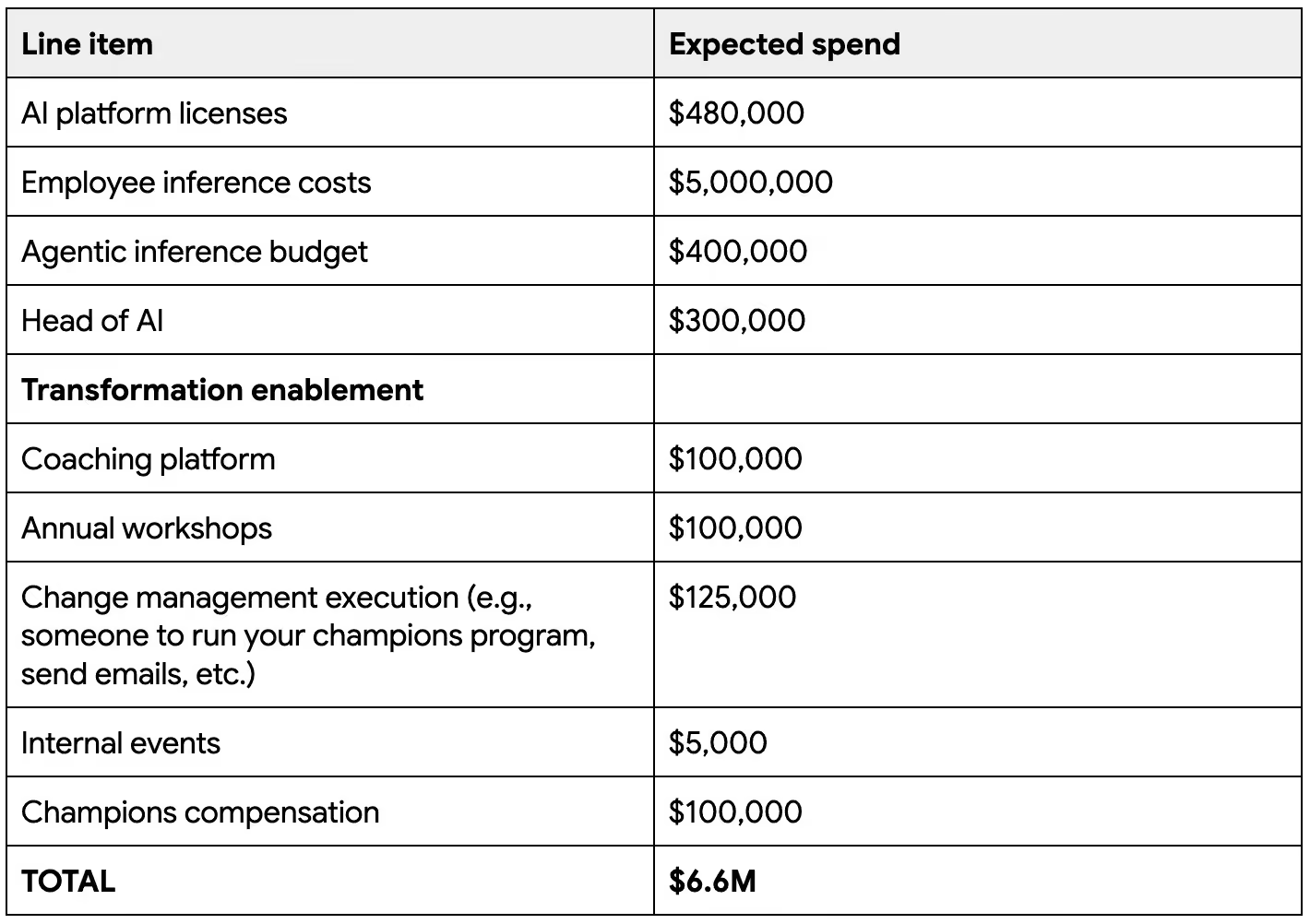
For a 1,000-person company going through a real transformation, about $6.6M a year. That's certainly bigger than most 2026 budgets. It's roughly what you'd spend on 60 additional employees.
So ask yourself whether AI, used well across the organization, could deliver more than 60 people's worth of value. For most organizations with a decent level of AI proficiency, the answer is yes by a wide margin.
If you're bigger or smaller, scale accordingly, but expect it to get a little cheaper per person as you grow. And if you're planning to go halfway and spend less, lower your expectations to match.
2. What goes into that number?
For simplicity, think of it in three categories:
License costs: This is the cost of giving people access to tools like Claude, Copilot, ChatGPT, or Gemini, and it should be about 7% of your budget. This is your most predictable cost, because vendors will quote you and this line item is about access rather than usage.
Inference costs: This is the cost of employees and agents actually using AI inference. It's what you pay every time someone asks a question or an agent runs a task. The more people use AI, and the more complex the work they give it, the higher it goes.
This line item gave CFOs and Heads of AI the most heartburn in 2026, because AI companies started charging for usage rather than just seats and costs skyrocketed. Going into 2027, expect inference costs to be about 80% of your total AI budget - more on this in a second.
Enablement costs: This is the last 13%, covering AI coaching, leadership staffing, champions programs, and change management. This part of the budget is easily overlooked but is critical to turning inference spend into business value.
3. How much should I spend on inference?
Employee inference comes to about $5M a year at full scale, or roughly $5,000 per person. The easiest way to budget it is as a percentage of salary. Plan on 2-5% for general knowledge workers and 5-7% for engineers and other technical roles, since they use AI for heavier work like writing code and building agents. Put your Head of AI, your champions, and the rest of your builder community in the technical group.
Agent inference gets its own line, budgeted per business process instead of per person. These are the bigger agents that run across functions, like one that pulls customer feedback from calls, tickets, and surveys for product, marketing, and sales. Expect about 20 of them by the end of your first serious year, at $1,500 to $2,000 a month each, topping out around $480K a year. Every one should launch with a cost ceiling and a clear idea of the value it's supposed to create.
4. Do I need a Head of AI?
Yes. Budget $200K to $400K fully loaded, depending on your market and how senior you need them to be. (If you've budgeted a million a year for the role, see me after class.)
I'm fully aware of how this sounds coming from a Head of AI, but this role needs to be a senior hire, ideally reporting to the CEO. This person has to drive change across the whole company and push back on senior leaders who aren't moving. That's very hard to do if AI is a side project for someone who already has a full-time job, or if they're too junior to get the right meetings.
5. What do I spend the enablement budget on?
For a 1000 person company, coaching should run you about $200K. That covers a platform that coaches people continuously and measures how capable your workforce is, plus activation workshops twice a year. You’ll also need a discretionary budget for events - AI webinars, lunch and learns, hackathons, etc. - which should cost about $2K per event.
Depending on how you structure it, a champions program is about $100K. About 5 to 10% of your workforce is already ahead on AI. Formalize their role and pay them for it, with real compensation or perks. Treat it like volunteer work and you'll get a volunteer level of commitment.
6. What should I bring to the budget conversation?
Three things: proof of what's already working, a clear picture of what you need to fund, and a plan for tracking returns.
For proof, a specific win, even a small one, carries more weight than anything you're projecting. Show where you brought AI into the business, like automating SDR outreach. Show the result, like a 5% increase in meetings booked. Then show what it means for your next initiative, like using the same approach so more new clients show up to their onboarding calls.
7. What if I don't have any wins yet?
If the answer is zero or close to zero, you're in bigger company than you think. You can still get a budget approved. You just need to ask differently.
Start with a smaller request, especially on inference, since that's where costs grow fastest and it feels the most abstract. Be specific about which workflows you'll go after first, and pick ones tied to KPIs your leadership already watches. Then ask for more as you prove value.
Think of your first budget as a way to earn your second. A CFO will fund a team that's honest about where it is a lot sooner than one pretending to be further along.
8. How do I measure return?
We think about AI return in three ways, from highest fidelity to lowest.
Measurable return is the change in individual workflows tied to revenue and cost. You look at a specific place you brought AI in and ask how the numbers changed. It's easiest where you already measure, like sales, go-to-market, and engineering.
Directional return is the change in key metrics at the team or function level, over time or by group. Whenever you roll out AI, you end up with adopters and non-adopters. The non-adopters become your control group.
Assumed return is the productivity gain from people using AI every day. It's the lowest fidelity and the widest-ranging. At Section, with about 50 people, our AI spend has to buy at least two employees' worth of extra output. I don't measure that precisely, but watching how AI has changed our work, it's an easy yes.
9. How do I show my CFO it's paying off?
Your CFO isn't going to argue about whether AI technically works. She wants to know how you'll know it's working in your company, and what you'll do if it isn't.
Start with the number she'll calculate anyway. On roughly $110M in payroll, a $6.6M budget needs about a 6% gain in revenue or savings to pay for itself. That's very achievable, but not in the first quarter, so don't promise fast payback. Promise a clear plan, and show you understand the bar.
In the first six months, you won't have much evidence, and that's normal. Between six and 12 months, managers should start reporting specific changes, like a vendor you no longer need or a weeklong process that now takes a day. Between 12 and 24 months, financial evidence shows up at the team level (in pipeline creation, bookings, code velocity, etc.). After two years, you should see work that wasn't possible before.
Commit now to reporting on AI value every quarter, including what isn't working. Next fall, you’ll have four quarters of evidence you can use to justify your next budget.
10. What can we cut to pay for it?
Your CFO is going to ask, so make it part of the plan.
Backfills are the biggest lever. A 1,000-person company with 12% attrition loses about 120 people a year, roughly $13M in payroll. I'm not saying close out every backfill, but close out a portion, probably 25%, and you free up about $3.25M. I wrote more about this in freeze backfills to fund your AI budget (yes, I got some complaints about it - but funding AI by freezing headcount is the reality in most enterprise organizations).
Vendors and agencies come next. Outsourced content, research, and support are where AI picks up first, so expect to cut about 15 to 25% of that spend.
Then software. Companies leave about a third of their SaaS licenses completely unused, and AI makes whole categories of tools redundant. I'm not saying you'll vibe code your whole CRM, but find what you can retire.
Last is learning and development, which is where your enablement money should come from. Keep the compliance training and cut the course library nobody finishes.
11. Should I ask for the whole budget up front?
No. Don't walk in asking for nearly $7M starting January 1. No CFO wants to fund a step function.
Ask for a ramp instead. Start at 40% of your full run rate in Q1, move to 80% in Q2, and reach full run rate by Q3. Tie each step to thresholds you agree on with your CFO in advance, based on either the value you're showing or how quickly people are building AI proficiency.
That brings your actual 2027 spend down to about 80% of the full number, which makes the request easier to approve.
12. Is this on top of what we already spend on cloud, data, and SaaS?
Yes. Your existing SaaS, cloud storage, and data platforms are all separate.
The infrastructure your agents run on counts as AI tool spend. When a company asks us to help build agents, the first thing we look at is where they can be built and deployed. Sometimes that's their existing Claude, Copilot, or ChatGPT environment. Sometimes it's an orchestration tool they've already brought in.
13. How do I keep inference from running away?
Runaway inference is one of the biggest worries in finance departments right now, but luckily solving it is a relatively straightforward exercise in discipline.
Set inference targets and enforce them with token caps.
Agree with your CFO in advance on how overages get handled. Some employees who aren't at the frontier today will be in two or three months, and they'll need more than you budgeted. Decide now who approves that and how much of an increase you grant for each request.
Build in 25-30% contingency. Our own inference at Section jumped in June when we rolled out a new set of agents. Inference grows with the usage you're trying to increase, so every bit of success shows up as budget variance. If you budget to the exact estimate, you'll be back asking for more by Q3.
14. $5,000 per person still feels like a lot. How do I defend it?
Look at it per team. For 10 knowledge workers, you're spending about what half of one hire would cost. After a year, did AI give that team more than half a person's worth of output? If your deployment is successful, the answer should be yes - but keep yourself honest about it.
15. How much of inference should go to experimentation?
My shoot-from-the-hip answer is 20-30%.
Experimentation rolls up into inference. That June jump in our spend was mostly agent experiments. Then it came down. Some experiments didn't work, so we killed them. Others we iterated to be more efficient, and in a few cases we merged two agents into one that could do both jobs.
If a pilot looks promising but hasn't proven it can scale, what you fund next depends on what you learned. Usually some parts of an agent are highly valuable and some aren't. Strip away the parts that aren't and keep going. We revisit the failed parts in about three months, because as the frontier advances, something that didn't work three months ago can work beautifully.
16. Is there a linear relationship between AI spend and outcomes?
I'd love to say yes, but no.
Sometimes we run experiments that cost a fair amount of inference and don't take us anywhere. That's fine. That's the point of an experiment.
It runs the other way too. Our September inference went down by a really noticeable amount, partly because our people got more judicious about picking the right model instead of the most powerful one every time. Some very high-value outcomes come from less powerful models.
17. Does enablement include employee time and outside help?
Employee time gets built into the budget in other ways, mainly through your Head of AI and your champions, who will carry a lot of the training and support.
They'll only get you so far, so external consultants are part of this budget too, and they belong under enablement. The exception is a consultant who helps you build AI features into your product. That goes in the product and engineering budget.
18. Does this change by industry, and where does governance go?
This isn't a budget for tech companies. Whether you're in manufacturing, healthcare, or tech, we're all trying to do the same thing, and the approach should be the same.
Governance is where industries really differ. Most of governance is decisions, and you don't need a budget for those conversations. Have a governance council, and bring them into the budget conversation up front.
Tools depend on your regulatory environment. Section is at one end of that spectrum. We don't buy governance tools to monitor our agents. We built internal systems for it, and that cost sits in our agent inference budget. Healthcare is at the other end of the spectrum. If I were a Head of AI in a highly regulated healthcare organization, I'd hope those tools already existed in a separate data governance budget. If they don't, that's where your budget will look different.
19. What are the biggest mistakes you see?
Thinking the AI budget is just access to the tool. That was the key mistake going into 2026. Companies didn't account for paying for tokens every time people used AI. Some then published token leaderboards, which led to token maxing, which was really just a generous donation program to the frontier labs.
Not protecting the investment. Enablement is how you protect it. Skip it, and by the end of 2027 most of your workforce will still be using AI to write better emails. Those emails get expensive, because you're paying inference on every one.
Not committing dedicated resources. You're not going to transform a company by asking a couple dozen people to spend half their time on it. That means a Head of AI.
All three come from not recognizing how much commitment real transformation takes. Too many companies still treat AI like a traditional SaaS rollout, the way they rolled out a CRM or an ERP. This changes week to week, and it takes a constant learning environment.
20. What might change in 2027 that would affect how this budget gets applied?
Predictions are a terrible business, but a few things are on my mind:
- Inference cost could go down significantly as models become more efficient. If the labs are serious about a slowdown to the Frontier, we are going to see more advancements to cheaper models like we saw last week with Opus 5.5. That might mean that we have more head room to do even more with AI. If inference cost goes down significantly, that means that we over-budgeted based on what we know today.
- On the flip side of the coin: We could see the Frontier continues to expand, despite the calls for a slowdown. That might make new, transformative use cases a reality - and those more advanced models at the frontier are almost guaranteed to come at higher inference costs, as we saw with Astra and Fable.
- Personal agents are going to be a big part of AI in 2027. Meta Muse and ChatGPT Dots are essentially personal assistants, running in the background and integrating into everything you do - and it’s unclear what that will cost.
If you want to run your own numbers, we turned the framework into a fillable AI budget worksheet. Before you walk into any budget conversation, know three things: what you're spending on AI today, what you plan to spend next year, and what has actually changed in the work. Bring whatever you can't answer to my Head of AI Office Hours on October 14.
See you next week,
Michael
Your fellow Head of AI

.svg)

.webp)