5 AI problems we'll all be facing in 5 years

By Michael Domanic, Section Head of AI
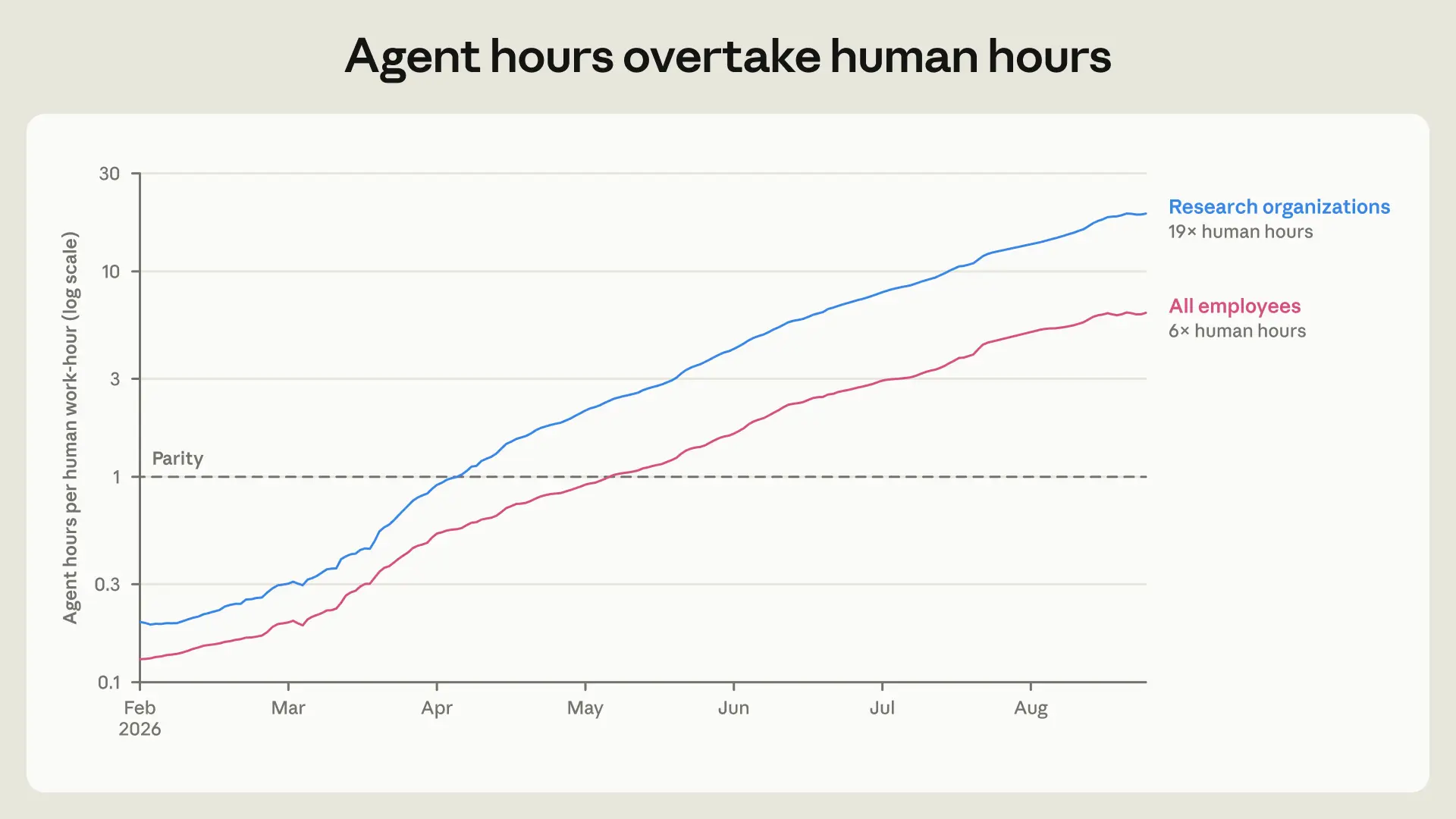
There's one chart in Anthropic's recent employment report that I haven't been able to stop thinking about.
This spring, agents started working more hours at Anthropic than humans.
Today, agents log six hours for every human hour company-wide, and 19 for every one in research.
I'm not sure most companies could even measure that yet, never mind hit it. But Anthropic is further down this road than almost anyone, and its S-1 and employment report give us an unusually detailed look at what an AI-native company runs into. Revenue per employee is over $6.6M, up from $1.4M a year earlier, and Claude wrote over 90% of codebase contributions in September.
Some of that is the advantage of selling one of the hottest products in tech (the report itself admits "it is easier to close deals when you sell a strong model"). But the operational challenges they describe have little to do with being an AI lab and a lot to do with agents doing a meaningful share of the work, which is where all of us are headed.
Here are five I think every AI leader should start preparing for now.
1. Your agents will spend most of their time waiting on you
About 80% of agent session time at Anthropic is spent waiting on people. Agents are already out-working humans six to one, and they'd do even more if people weren't asleep, in meetings, or on PTO.
I see this all the time. I'll come back to my desk to find Claude sitting idle, waiting on a yes from me.
That's a case for more autonomy. You don't need to take humans out of every loop, but you should be deliberate about which loops actually need them. Blast radius and reversibility are a good place to start: if an action is low-impact and easy to undo, an agent probably shouldn't be waiting on a person to approve it. Look at where your agents stop to ask, and how many of those stops are protecting you from something real.
2. Human-in-the-loop review won't scale
When most people say "human in the loop," they mean review. The agent produces something, and a person checks it the way they'd check a coworker's work. Anthropic's numbers suggest that model is close to its limit. Reading all the agent output in engineering and research would take 424 hours a week per person, in a week that has 168.
And this is a company with some of the most sophisticated agent evals in the world. Even so, they haven't given agents full autonomy, and they can't read everything the agents produce.
I don't have the answer yet, but a few directions seem promising. One is agents that check other agents' work (or their own) before anything reaches a person. Another is a more rigorous development process up front, so the testing happens before an agent goes live and you aren't stuck being its editor forever. A lot of agents get pushed live the moment they do something useful, and that's how you end up reviewing everything.
What I am confident about is that "always check the AI's work" won't be the plan for much longer. Someone in your organization needs to start designing what oversight looks like when reviewing every output isn't possible.
3. AI will overtake headcount as your biggest operating expense
At Anthropic, internal Claude usage (at list prices) grew more than 250x between January and September 2026, and in April it passed the company's monthly personnel expense, excluding stock comp.
Again, Anthropic is a special case - it's using its own product, and list price isn't what that usage actually costs them. But the direction applies to everyone. Over the next few years, your headcount costs may hold flat or even come down while your AI costs keep climbing.
Most companies aren't budgeting for that. AI spend usually gets managed like software, with a price per seat that's easy to forecast. Agent costs behave more like labor. Your costs will scale with how much work the agents do and the complexity of that work, and if you take problem #1 seriously, that's the number you're trying to grow.
I'd get finance involved now, before the bill surprises anyone. Put AI spend and headcount in the same planning conversation, and measure AI on cost per outcome rather than cost per seat. It's also worth asking what your agents' work would cost if people were doing it, and whether you'd pay that price. And more important is assessing the value of the outcome the agents generate.
4. The junior pipeline will thin out
Anthropic tripled in size and still describes itself as "clerical-light." Junior roles went from 21% of technical headcount to 14%, and junior hires dropped even faster, from 27% of technical hires to 9%.
What they're hiring for has shifted too. Mentions of AI skill in interview scorecards tripled for technical roles and quadrupled for non-technical ones, and judgment and autonomy now get more weight than domain expertise. If agents handle more of the execution, the moments when humans step in carry more weight - so judgment becomes the thing you hire for.
The open question, which we've been asking for years, is: where will future senior people come from if the junior roles where people used to build judgment keep shrinking?
If you have a hand in hiring or workforce planning, I'd start adding judgment and AI skill to your scorecards now, and think about how people will build judgment without the junior years.
5. Everyone becomes a manager (of agents)
At Anthropic, more than one in five agent sessions is now spent managing agents, like building tools for them or supervising their work. Employees also write about 8,500 sets of standing instructions for agents a year (think of them as SOPs or job descriptions).
In practice, almost everyone at Anthropic is now managing a team - of agents. They decide what to delegate, write instructions, give context, check results and figure out when to step in. Those are management skills, and most people have never been trained in them because they've never had direct reports.
At the same time, the human management layer is getting thinner. Managers are spending more of their time doing the work themselves, and the org is much flatter. So a lot of people may end up managing several agents with minimal guidance or coaching from their own boss.
That changes what support needs to look like. Most enterprise AI training still teaches people to use AI as an assistant, but the next skill is managing agents, and people will have to learn it with less day-to-day oversight than they've ever had.
The head start
Most companies are at least a year away from six agent hours for every human hour. That gap is actually a good thing (unless you're competing directly with Anthropic), because you get to see these problems before you have them.
Start thinking about them now, and plan to be tackling them in two years.
See you next week,
Michael
Your fellow Head of AI