


.svg)
.svg)
What Should Be in Your AI Budget for 2027

By Michael Domanic, Section Head of AI
Budget season is coming, and if your 2027 AI budget looks anything like your 2026 one, you're under-spending in the wrong places and over-spending in others.
Most companies I talk to have a line item for AI platform licenses and maybe some vague allocation for “AI initiatives.” Here's what an actual AI transformation budget should contain, with rough numbers you can adapt to your organization.
A few notes:
- All numbers are based on a 1,000-person organization. Extrapolate according to your org size, though assume that most numbers (enterprise licenses, transformation costs, etc.) will benefit from economies of scale.
- This budget covers your internal AI transformation, not the work to build AI into your products or the inference spend generated by your customers’ use of AI features in your platform.
- If you want to discuss how we can support, my team would be happy to - find time here.
The essential line items in an AI transformation budget
1. AI platform licenses
This is the one most orgs already have - an enterprise AI platform for every knowledge worker in your organization (Claude, ChatGPT Enterprise, Gemini, whatever you've standardized on). If you haven't standardized on one platform yet, do that before you budget for anything else. The cost here is relatively predictable and the vendors will quote you.
Expected cost for a 1K-person org: ~$480 per employee per year or $480,000 total, for an enterprise account with volume discounts applied
2. Employee inference costs
This is the line item most companies either don't have or dramatically underestimate. And it’s separate from your platform license - it's the consumption cost of using AI for real work, especially agentic workflows that burn through significantly more tokens than basic chat.
AI token costs are easily the largest part of an AI budget, so you need to scale this one up or risk giving your CFO a heart attack. Don't jump from $0 to $5M in token spend overnight. Start with one team of 100 and prove the value.
Long-term, once the value is (at least directionally) proven, you should budget 2-5% of salary costs for knowledge workers and 5-7% for engineers and technical roles (that have access to a tool that charges for inference). For a knowledge worker making $110,000, that's $2,000 to $5,000 per year. For an engineer at $200,000, that's $10,000 to $14,000. For the sake of budgeting inference, consider your Head of AI and AI champions part of your “technical” pool, regardless of where they sit in the org.
Those numbers probably still feel intimidating, so think about it this way: you're spending the equivalent of a fraction of an additional hire per team, and the question after 12 months is whether you got that value back. At Section, our total inference cost across the company is roughly equivalent to 2 FTEs - and we're getting significantly more than that in output.
Expected cost for a 1K-person org: $5K per employee per year, or $5M total (scaled up over time)
3. Inference budget for high-value agents
Your company’s centralized agents will consume meaningfully more inference than an individual's daily use - things like automated prospect outreach, client intelligence automation, or anything running on a schedule across the org.
Budget for these separately from individual employee inference. Employee inference is priced per person. Centralized agent inference should be priced per business process, because that is what these agents actually run.
By the end of your first serious year, expect around 20 centralized agents in production, each serving a large cross section of the org. At $1,500 to $2,000 a month in inference apiece, that's $360,000 to $480,000 annually, and every one of those agents should carry a cost ceiling and a value hypothesis before it ships.
Expected cost for a 1K-person org: $360,000-$480,000 per year
4. Head of AI
If you don't have one, budget for one. This should be a senior hire - someone with the authority to drive transformation across the organization and the credibility to push back on people who aren't moving.
Expect to pay $200,000 to $400,000 fully loaded, depending on your market and the seniority you need. This is the single highest-leverage line item in the budget, because without it, everything else on this list gets deployed without coordination and you end up with scattered adoption and no accountability.
Expected cost for a 1K-person org: $200,000-$400,000 depending on market
5. Transformation enablement
Transformation is a massive umbrella, but it breaks into a few “must haves” that you should budget for now.
- Coaching (platform + workshops). Enablement platform that coaches employees continuously on AI fitness and measures AI fitness across your organization. Ideally paired with activation workshops 2x a year to re-energize your team as AI evolves. Expect to pay at least $200,000 for a platform and a schedule of activation workshops annually.
- Change management (ownership + events). Internal or consultant support to execute your change management plan, including lunch and learns, office hours, AI hackathons, and more. Expect to pay $125,000 on consultant support or an internal hire, plus ~$5,000 (per 1000 people) for dedicated internal events a few times a year.
- Champions program. Identify the 5-10% of your workforce who are already ahead on AI and formalize their role as internal catalysts, complete with additional compensation. Expect to pay $2,000 per champion per year in direct compensation or perks, plus the opportunity cost of their time.
Expected cost for a 1K-person org: $430,000 annually
The total picture
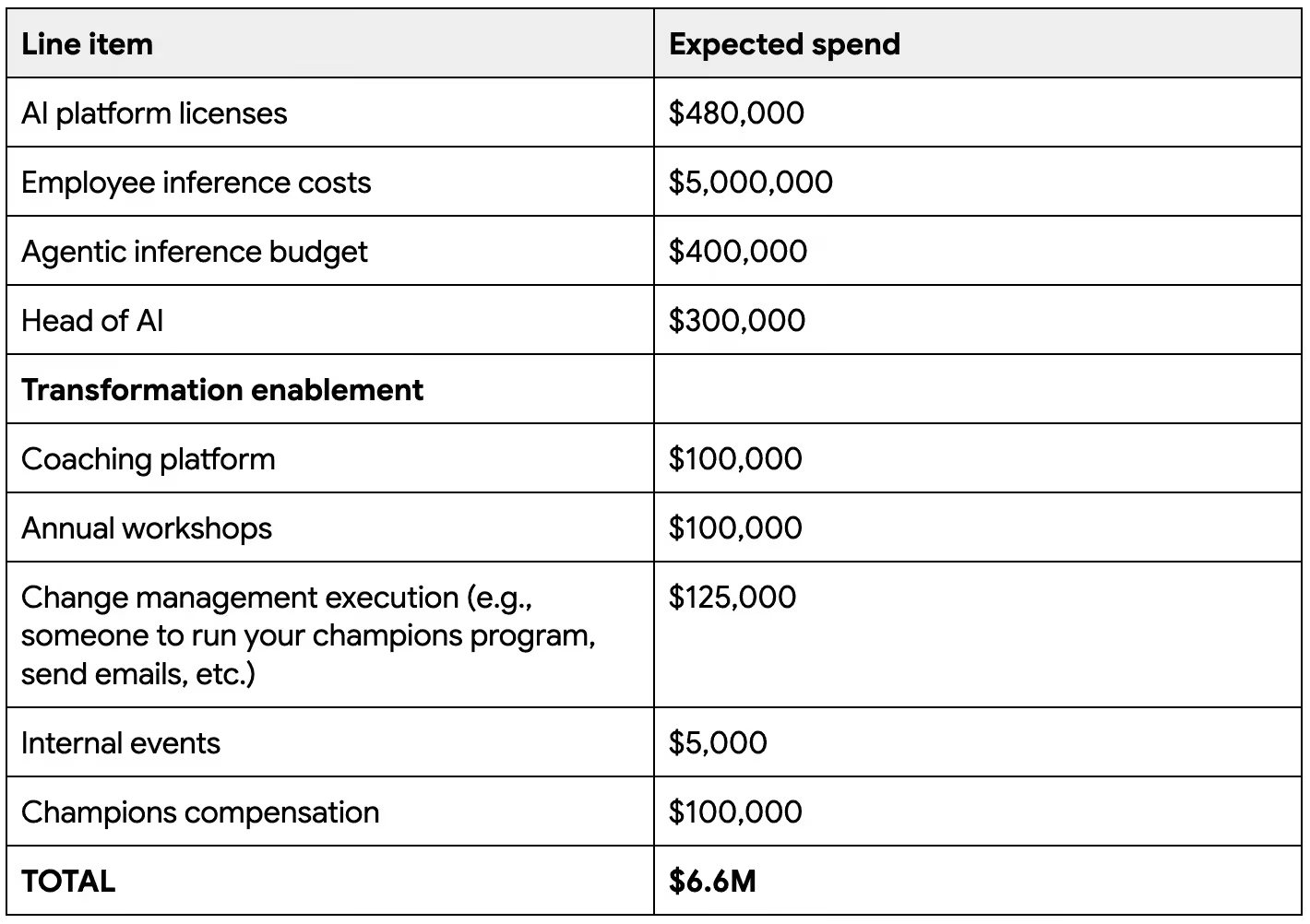
Total range for a 1,000-person org: roughly $6.6M per year, with inference being the largest and most variable component. That's 6% of your total salary costs, or the equivalent of about 60 additional employees.
The conversation you will have with your CFO
Your CFO is not going to argue about whether AI works. That debate ended. She is going to ask how you’re going to track ROI and what the business is cutting to pay for this, and you need to prepare an honest and defensible answer before you walk into that conversation.
Start with the math. If your payroll is $110M, a $6.6M AI budget has to produce about a 6% outcome gain just to pay for itself. You should acknowledge that - your CFO is going to run the number anyway, so it’s better she hears it from you.
But don’t promise to get to those outcome gains right away - that’s just foolish. Instead, show her three things:
- Your expectations for proving ROI in the next 2 years (in stages)
- Your plan to manage the inference budget
- Where you see the most immediate opportunities to realize savings from AI
1. Have a 2-year plan to demonstrate success - but don’t force it. In the first 6 months of AI deployment, you won’t see much evidence of ROI - looking for numbers this early misreads the signals or spends time looking at the wrong thing. By 6-12 months, you should have some specific, concrete workflow changes (e.g., higher opportunity rate from AI-assisted follow-ups).
By 12-24 months, efficiency should be visible at the team level via lower headcount requirements or scope expansion without hiring. Share these expectations with your CFO, but don’t force an ROI number (especially early on) if you can’t measure or prove it.
2. Have a plan to manage your inference budget. There’s a lot of heartburn around runaway inference cost right now in the CFO office, so you need to demonstrate that you have a plan to manage spend. First, know your target inference budget per knowledge worker and technical worker, and set token caps within your LLM so that employees can’t blow through the budget. Agree with the CFO on a process to approve overages (or not) as employees hit their limits.
And build a 25-30% contingency into your inference lines. Inference is hard to forecast, because it scales with usage you are actively trying to increase. Every dollar of success shows up as a variance. If you budget to the point estimate, you will be back asking for more money in Q3, and that could cost you far more credibility than the contingency will cost you in negotiation. Ask for the cushion up front and explain exactly why you need it. A CFO who understands the variance will likely exercise flexibility.
3. Show the immediate opportunities to realize cost savings from AI. Your mileage may vary, but across clients these are the usual “low hanging fruit” we see to start cutting costs with AI.
- Hold a quarter of your backfills. A 1,000-person org with 12% attrition churns 120 roles a year, roughly $13M in payroll. Hold 25% of those backfills for twelve months and you have potentially funded $3.25M. Pick the roles where you already have something working. If an agent has been successfully handling a chunk of a specific job for two quarters, that is the backfill you hold. No layoffs and no headcount announcement.
- Cut vendor, agency, and BPO spend. McKinsey puts indirect spend at 10-18% of revenue depending on industry. A meaningful slice of that is outsourced content, research, design, contract development, and offshore support. That is exactly the work agents absorb first. A 15-25% reduction against that slice covers most of the AI budget. Make sure you frame this correctly: you are insourcing external labor at a lower unit cost, so this is a substitution, not new spend.That single sentence does more work to justify the AI transformation budget than anything else on this list.
- Consolidate software. Zylo's 2026 index, built on 40 million licenses and $75 billion in spend, finds that organizations leave 36% of their SaaS licenses unused. Separately, AI absorbs entire categories: transcription tools, research subscriptions, content point solutions, low-end automation. Between dead seats and tools you no longer need, 10-20% of software spend is recoverable, and that feels like a conservative read of the data.
- Reallocate L&D. Most orgs carry $1,000-$2,000 per employee in learning and development. Your transformation enablement is now the most critical line item in your L&D budget. Leave the mandatory compliance spend alone because, well, that’s required. Go after the discretionary half, which in most companies is an outdated course library with completion rates in the single digits. AI fluency is the rare training investment where you can measure the output directly. Trade stale content for the most critical set of skills in business transformation history.
Now, how you ask matters as much as what you are asking for. Do not walk in requesting nearly $7M effective January 1. Request a ramp: 40% of run rate in Q1, gated on adoption and proficiency thresholds you agree to in advance, full run rate by Q3. It will make more sense to fund a ramp than a step function.
If you have questions about this, shoot them my way. Budgeting is no one’s favorite process, but if you get started now, you’ll have time to iterate.
See you next week,
Michael
Your fellow Head of AI



.svg)
.png)

.webp)