
Building
AI-Powered
Organizations
The Inference Economy
For decades, growth meant headcount. Double revenue? Double the team. Enter new markets? Staff up accordingly. The constraint was always the same: how many qualified people can you hire, onboard, and manage effectively?
That constraint is breaking.
AI-powered organizations achieve faster growth with smaller teams by leveraging inference rather than just headcount. Organizations are discovering that AI’s ability to analyze, synthesize, and execute at machine speed can drive growth without proportional headcount increases.
This isn't about replacing people. It's about fundamentally restructuring how work gets done, who does it, and how quickly decisions move from insight to action. It looks like teams of 50 operating with the output of 150, products launching in weeks instead of quarters, and companies entering new markets without building entire departments first.
This playbook outlines the three-stage journey to building an AI-powered organization, based on research and experience with 150+ enterprise organizations.

The Three Components of an AI-Powered Organization
An AI-powered organization isn't built through a few workshops and lunch and learns. It's built through three distinct, measurable components that work together to create sustainable transformation.
AI-Powered Team
Target: 80% of employees using AI every day
The foundation of transformation. Every employee has access to high-quality enterprise AI and uses it every day for high-value work. AI becomes a daily habit, not an occasional experiment.
AI-Automated Workflows
Target: 1:1 self-built agent to desk worker ratio
This component moves beyond individual productivity to automated workflows. Agents handle discrete, repeatable processes, from lead qualification to contract review to incident triage.
AI-Reinvented Business Processes
Target: 1-3 core processes where 80%+ of work is executed by agents
This is the apex of transformation – mission-critical processes redesigned around AI agents with entirely new operating models. Humans shift to strategy, exceptions, and relationship-heavy decisions while agents handle continuous execution.
How to Build: The Three-Stage Journey
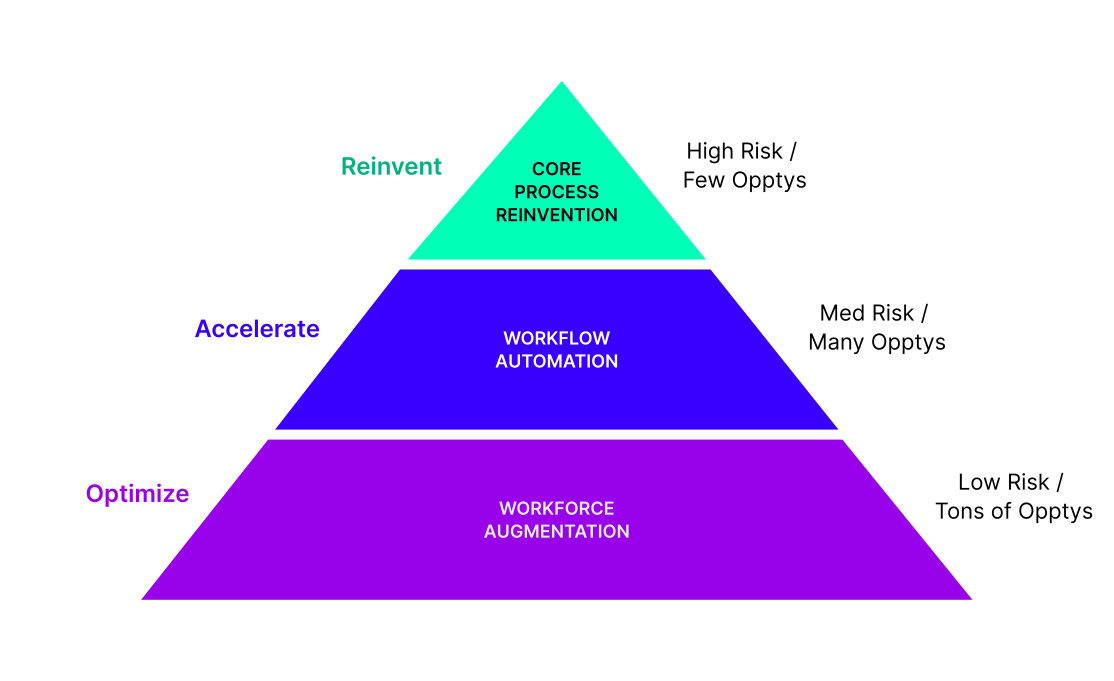
Every AI-powered organization must move through three distinct stages of maturity: Optimize, Accelerate, and Reinvent.
The most successful organizations will progress sequentially, creating the groundwork of an AI-augmented workforce first. Attempting Reinvent without Optimize typically fails because the workforce lacks the AI fluency and cultural readiness to support automation and process reinvention.
Optimize Via Workforce Augmentation

What Success Looks Like
Your organization has succeeded in optimizing when AI use is ubiquitous and habitual.
Every employee has access to world-class AI, managers model AI use and drive adoption in their teams, and custom GPTs, Gems, or Copilot Agents proliferate. Individual contributor work shifts meaningfully from execution to judgment, freeing bandwidth. Teams can clearly articulate their top 5-10 repeatable, language-heavy workflows – candidates for automation in the Accelerate stage.
80%
daily active users (work days) of enterprise AI
80%
of desk workers at level 3 (of 4) of AI proficiency
(frequency, depth, and sophistication of use)
The “Optimize” Playbook
Build the Strategic Foundation
Create the conditions for AI to scale fast
The foundation determines everything that follows. Without clear strategy, executive sponsorship, and operational clarity, AI adoption remains scattered and inconsistent.

Organizations that articulate a clear, business-grounded “why” for implementing AI see 2-3x higher adoption rates. Employees need to understand not just how to use AI, but why it matters to the company's success and their own work.
Weak: “AI will make us more efficient”
Strong: “AI lets us deliver measurable client outcomes at 2x our current speed, helping us lead the market and outpace our competitors”
Drive Sustained AI Use
Turn access into behavior change
Access doesn't equal adoption. The gap between providing tools and creating habits is where most transformations stall. This phase is about deliberate activation – getting people using AI, then using it well, then using it daily for high-value use cases.
Manager attitude toward AI is a strong predictor of employee AI proficiency. Employees whose managers expect AI use in day-to-day work are 2.5x more proficient with AI than those whose managers discourage it.
Accelerate Via Workflow Automation
.svg)
What Success Looks Like
Your organization has reached Accelerate when the organization has a functioning agent for every employee.
Builders are embedded in every function with access to agentic platforms. AI has access to company data and institutional knowledge. Automations are embedded into existing tools – Slack/Teams, CRM, ticketing, documentation. Teams run tens of automation pilots per year. You see measurable improvement in significant KPIs (churn rate, close rate, roadmap velocity) directly attributed to new workflows.
1:1
self-built agent to desk worker ratio
(growing toward 3:1)
1-3
major agentic apps with 80% weekly usage per division/function
.svg)
The “Accelerate” Playbook
Build Your Automation Pilot Engine
Create the factory for strong experiments
The Accelerate stage is fundamentally about building an experimentation engine – one that generates, tests, and scales workflow automations at high velocity.
The Prioritization Framework
Value: What business impact will this create? (Revenue, cost savings, customer satisfaction, speed to market)
Velocity: How quickly can we build and test this? (Weeks vs. months)
Viability: How technically feasible is this with current tools and data? (High/medium/low)
Prioritize workflows that score high on at least two dimensions. Skip workflows that score low on all three.
Embed AI Into Workflows at Scale
Make wins stick
Successful pilots don't automatically become standard practice. This phase is about institutionalizing wins – turning experiments into repeatable processes that scale across the organization.
Reinvent by Redesigning Business Processes
.svg)
What Success Looks Like
Your organization has reached Reinvent when 1-3 mission-critical end-to-end processes are redesigned around AI agents with entirely new operating models.
This means agents run continuously, with humans shifting to setting strategy/constraints, handling exceptions, quality review, and relationship-heavy decisions. Agents read from enterprise data AND take actions in core systems with clear permissions and audit trails. Cycles that were weekly or monthly become daily or intraday, and organizational structure starts to change.
10-20x
improvement in 1-3 primary business KPIs (business-dependent)
80%
of eligible work for core business process is executed by agents
.svg)
The “Reinvent” Playbook
Identify and Redesign
Choose the few bets that change the business
Reinvent is not about automating everything (to start) – it's about redesigning the 1-3 processes that matter most to your business. These are high-leverage, high-risk bets.
Design the future-state operating model:
- What decisions do agents make vs. humans?
- What data do agents read from?
- What systems do agents act in?
- Where are human review, escalation, and override points?
Build, Deploy, and Operate
Make agents safe to act in systems of record
This is where strategy meets execution. You're giving AI agents permission to take actions in your most critical systems, which requires extraordinary care.
The Path Forward
Building an AI-powered organization isn't a one-time project. It's a multi-year journey that reshapes how your organization operates. The three stages – Optimize, Accelerate, Reinvent – provide a roadmap, but every organization's path will be unique.
The organizations that execute this journey well won't just be more efficient. They'll operate in a fundamentally different way – making decisions faster, experimenting more boldly, and leading their markets in innovation. That's the promise of inference over headcount: not just doing the same things cheaper, but doing entirely new things that weren't previously possible.

