


.svg)
.svg)
5 questions every AI leader will need to answer in 2027

By Michael Domanic, Section Head of AI
It's been nearly four years since ChatGPT launched, and we're officially in what I've been calling the hangover stage of enterprise AI. The hype has worn off a bit, and the invoices have come in. And for most Heads of AI, 2027 is going to be the first year where someone actually holds you accountable for results.
Most organizations are somewhere between experimentation and operationalization right now. A few advanced ones are already redesigning how work gets done. But regardless of where you are, the questions your board and your CEO are going to ask you next year are getting harder. Here are the five I'd prepare for.
1. Do you have an AI strategy, or a collection of AI projects?
Poor AI deployments produce a lot of “stuff.” Agents that overlap, half-finished AI projects, out-of-date skills, etc. That’s okay in the experimentation phase, because you want people trying things even if they won’t amount to anything. But after a year of that, you need to start moving people intentionally toward creating value.
Start with two things: A strategy and an audit.
The strategy doesn't need to be complicated. You need a manifesto that communicates the urgent, differentiated reason for implementing AI at your specific organization. You need one to three core goals, like “reduce customer service costs 2x by the end of 2027.” And you need an ownership structure that makes clear who's responsible for AI at the org level, the department level, and the team level, including who builds and maintains the agents.
Then do an audit of what you’ve built so far, and how it’s managed.
- Do you know what people across the org are building with AI?
- Do you have a catalog of cross-functional and department-level agents?
- Are you tracking experiments and making sure the ones that fail get retired?
- Is anyone coordinating across teams to prevent duplication?
- Do you know what you're spending on inference and - directionally - what you're getting from it?
If you can't answer those questions, that's the first thing to fix.
2. Are people just doing work faster, or doing work that wasn't possible before?
There's a stat from Deloitte I keep coming back to: 42% of frontline workers report saving at least eight hours a week with AI, but ⅔ of employees receive limited or no guidance on what to do with the time they've saved. We call this “cut vs. create” - and you need to do both.
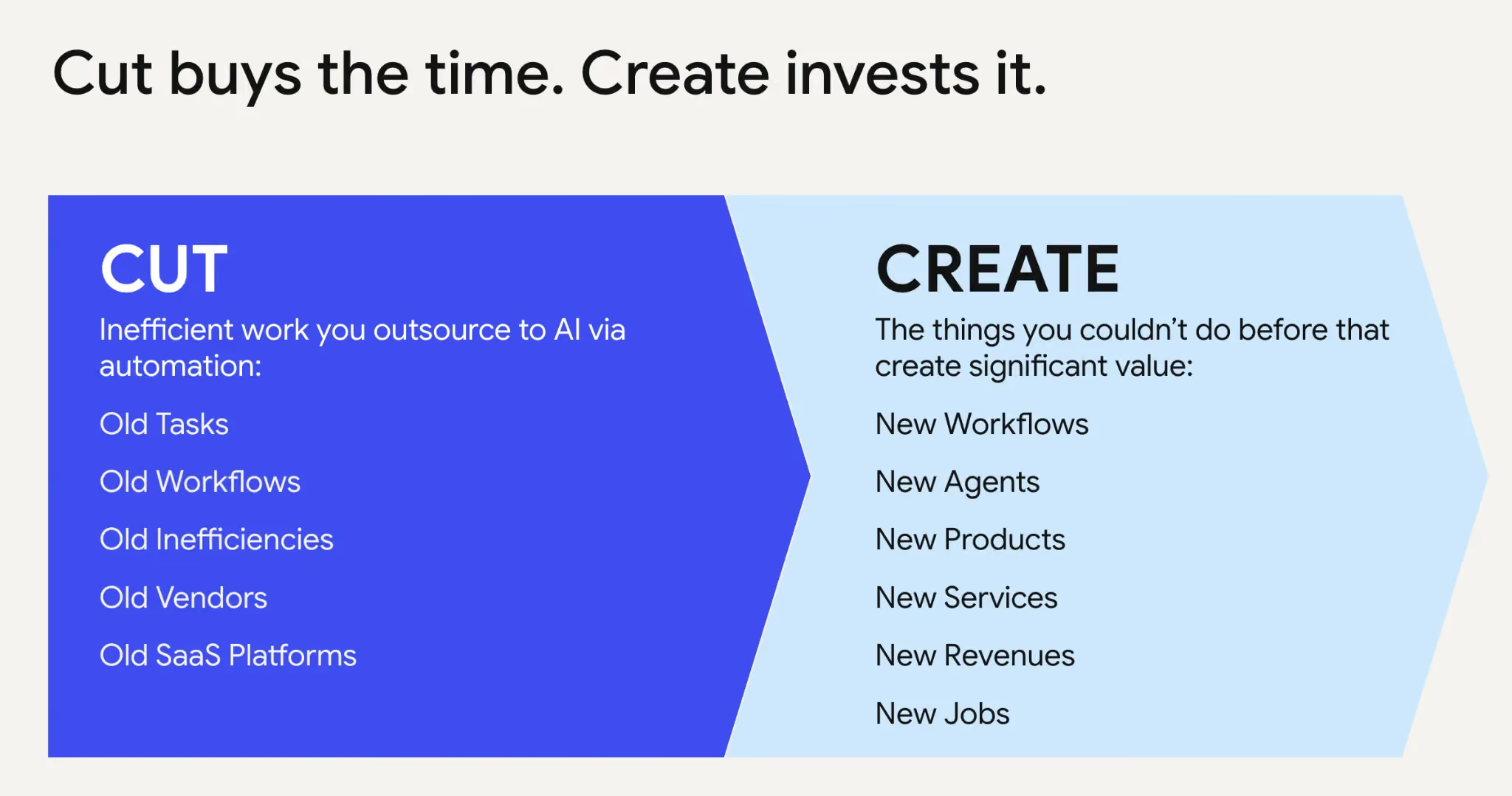
“Cut” is the first part, time savings - you augment your work with AI and in the process cut tasks, workflows, vendors and platforms that are no longer necessary. This buys you time and budget.
“Create” is what you do with that time and budget. That means new workflows, new products, new services, and new revenue streams that weren't possible before AI because you didn't have the capability or the capacity.
Cut mode is critical to get early wins, but your job as Head of AI is to move people quickly into create mode. Guide that conversation at every level of the org - from individual contributors figuring out what tasks they can stop doing, all the way up to the enterprise level asking what new business lines they can now pursue.
3. How many AI agents are burning tokens but not driving value?
Only about 21% of organizations report having a mature governance model for AI agents. That means the vast majority of companies with agentic access have employees building agents, running them on schedules, and then forgetting about them. When you multiply that by 1,000s of employees, “ghost agents” cause a real budget problem.
I think about agents in three tiers. Personal automations are built and maintained by individual employees, run locally, and have single-user impact - those can be relatively unmanaged. Team or functional agents are shared across a department and access team-level data, so they need a clear owner, which is the team's manager coordinating with your Head of AI. Business-wide agents are integrated with core systems like your CRM or ERP, and failure has org-wide consequences - those need to be managed by your AI team or product management.
For practical governance, I'd recommend giving every personal agent a 30-day expiration by default, automating usage audits that flag anything burning tokens without clear output, requiring every department lead to manage their department's agent suite, and planning now for what happens when an employee who built a critical agent leaves the company. That last one is not hypothetical - we've dealt with it at Section and it's messier than you'd think.
4. If you audited your AI transformation, what would you find?
The benchmarks for what a high-performing company looks like are being completely reset. Anthropic generates roughly $12 million in revenue per employee. OpenAI is at about $5.5 million. Compare that to Salesforce at $700K or ServiceNow at $400K. Those are AI companies, obviously, but the gap signals where every knowledge-economy sector is headed - and how far most organizations have to go.
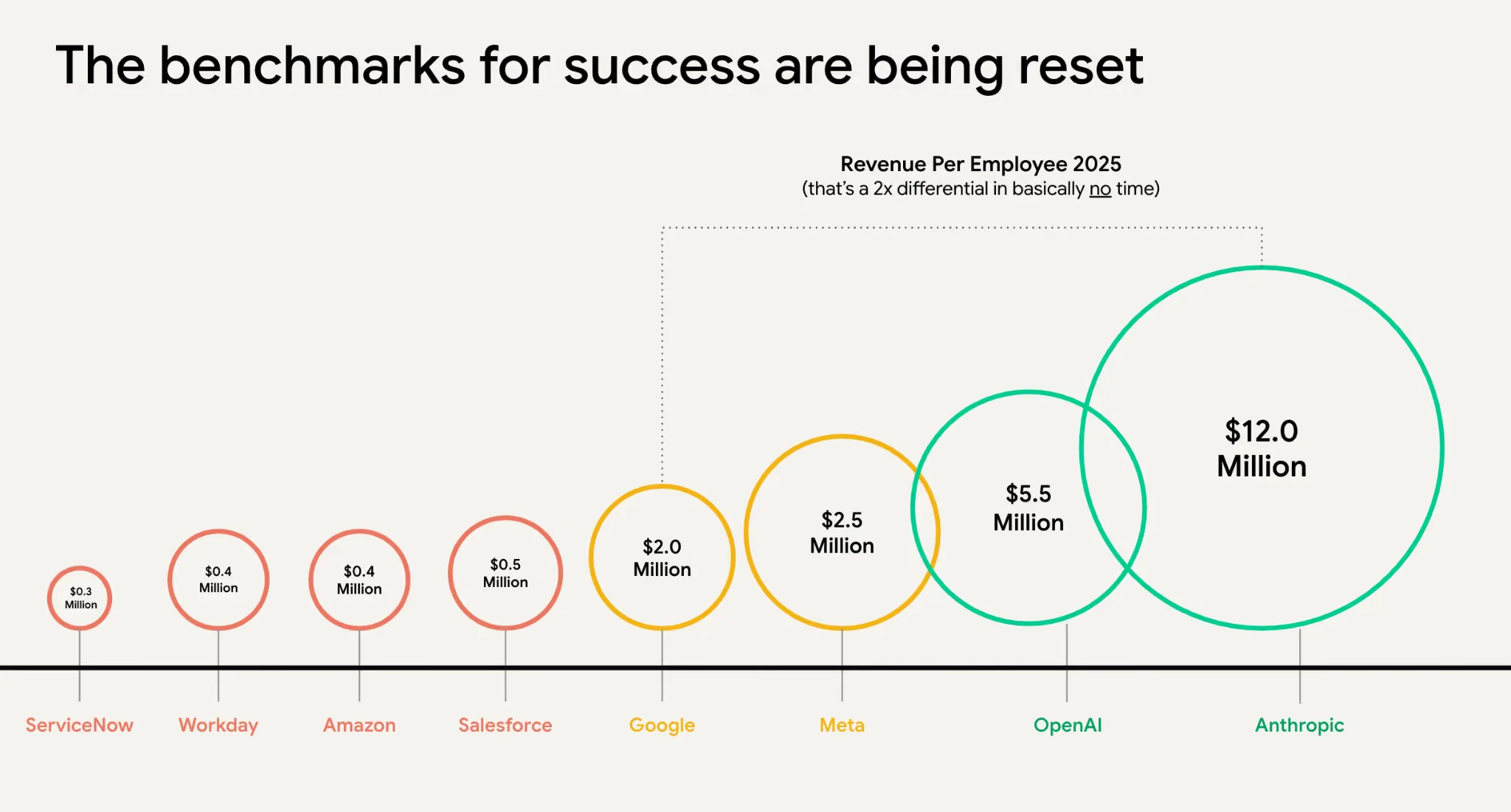
A competent board is going to ask you four things: how many people are using AI with meaningful proficiency, how many agents you have running, how AI is impacting your core business drivers and at what cost, and what your risk exposure looks like and how it's being managed.
An advanced board is going to ask something harder: are you rethinking the fundamental measurements of the business against what's now possible? Which of your current KPIs assume the cost structure you had before AI? Are you still pricing, staffing, and measuring by input - time, headcount, effort - now that output has decoupled from input? What would this business look like if you built it from scratch today?
The second set of questions will produce a more interesting and far-reaching discussion, so start answering them for yourself now.
5. It's been 12+ months - where's the ROI?
This is the question that keeps every CEO, CFO, and Head of AI up at night, and the honest answer is that AI ROI shows up on a longer timeline than most executives expect. Here’s the rough timeline:
- First six months: no real financial evidence. Looking for hard numbers this early either misreads the signals or means you're spending time on the wrong thing. This is the habit-building phase, and the investment is in capability, not outcomes.
- 6 to 12 months: the evidence is qualitative - manager observations about specific workflow changes and their impact on workflow-level KPIs. These are real and they matter, but they require managers who are paying attention and bought into the program.
- 12 to 24 months: financial evidence starts to emerge at the team level. Teams should be able to cut vendors or contractors that they no longer need, workflow-level metrics start impacting core KPIs around revenue and cost, etc.
- Beyond 24 months: net-new value gets created - things that exist now that didn't before, and core KPIs that are being reimagined because the underlying cost structure and capability of the organization have fundamentally changed.
For where most organizations are right now, I'd focus on three ways to think about return. The first is measurable: pick your 5 to 10 centralized agents and look at the cost to run them versus their impact on immediate KPIs, then extrapolate to revenue or cost impact. The second is directional: track your key functional metrics and see whether you can correlate changes to AI usage, either before-and-after or by comparing AI-heavy users to AI-light users. The third is assumed: take your total inference spend, convert it to FTE equivalents, and ask whether you're getting that many additional employees' worth of output. For a 250-person marketing team spending $250 per month per person, that's $750K annually - roughly the cost of seven employees. Are you getting the equivalent of seven additional people? If the answer is yes, the math works.
My advice
Answer these five questions for yourself before someone else asks them. Start budgeting for 2027 now if you haven't already - inference costs, transformation enablement, agent governance, and the dedicated headcount to manage all of it. And be prepared for the questions to change, because they will. The boards and CEOs who were asking “are people using AI?” in 2025 will be asking “why hasn't our cost structure changed?” by 2028.
See you next week,
Michael
Your fellow Head of AI

.svg)


.webp)